Home
Home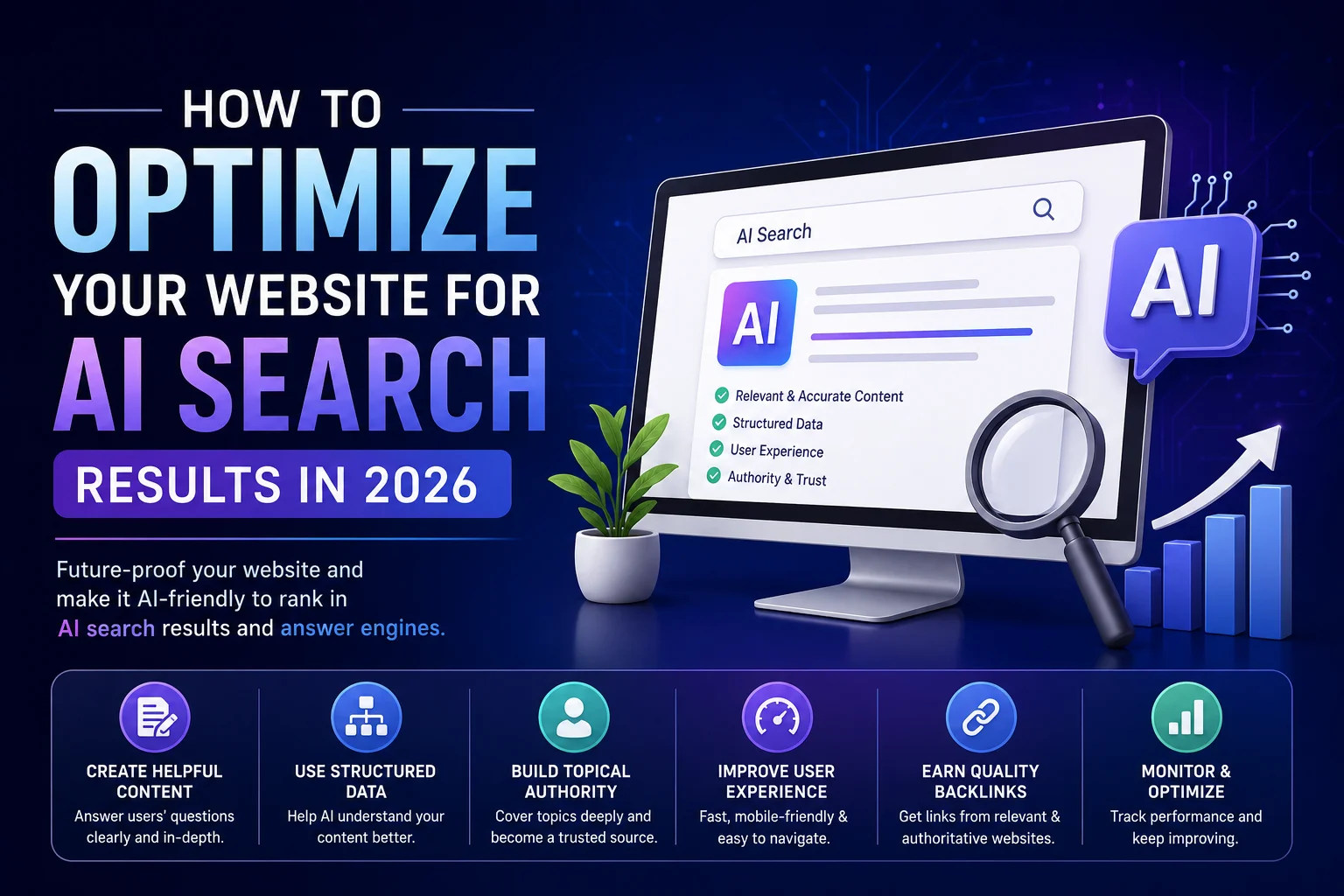
Something significant changed in how Google works in 2024 and 2025.
When you search for almost anything now — especially questions and comparisons —
Google shows an AI-generated answer at the very top of the page,
before any organic results, before any ads, before any maps.
This is Google’s AI Overview — and it is fundamentally changing how Indian businesses
need to think about search engine optimization in 2026.
If your content is not structured to be cited in AI answers,
you are invisible at the most important position in search results.
In this complete guide, you will learn exactly how AI search works in 2026
and the specific optimizations that get your Indian business website cited and featured
in AI-generated search results.
What is AI Search and How Does It Work?
Traditional search showed you a list of 10 blue links and you clicked one to find your answer.
AI search generates a direct answer using information pulled from multiple websites —
synthesizing content into a single response that users read without clicking through to any site.
- Google AI Overviews: AI-generated summaries at the top of Google results — launched in India in 2024
- ChatGPT Search: OpenAI’s search integration that pulls from websites to answer queries
- Perplexity AI: AI search engine increasingly used by Indian tech-savvy audiences
- Microsoft Copilot: Bing’s AI search with citations from web sources
When AI systems answer a search query, they pull information from websites they consider
authoritative, well-structured, and genuinely helpful.
Optimization for AI search means making your content the source these systems prefer to cite.
How AI Search is Different From Traditional SEO
- Traditional SEO: Rank your page in position 1 to 10 → user clicks your link → traffic to your site
- AI Search: Your content is cited in an AI answer → user gets answer without clicking → less traffic but more brand visibility and authority
- Winner in AI search: Content that directly, concisely answers specific questions with clear structure
- Loser in AI search: Generic, thin content with no specific answers, vague paragraphs, keyword-stuffed pages
The good news: the content optimizations that help you appear in AI search results
also improve your traditional SEO rankings. They are complementary, not competing strategies.
8 Specific Optimizations to Get Cited in AI Search Results
1. Write Direct, Concise Answers to Specific Questions
AI systems look for content that answers questions clearly and directly.
The most cited content in AI Overviews provides a complete, useful answer
in the first 2 to 3 sentences after a heading — without burying the answer in paragraphs of preamble.
- Use question-based H2 headings: “How much does website development cost in Surat?”
- Answer the question in the very first sentence after the heading
- Keep the direct answer to 40 to 60 words — expand with supporting details below
- Avoid starting answers with “It depends” — give a specific answer first, then add nuance
2. Add Comprehensive FAQ Sections to Every Page
FAQ sections are one of the most powerful formats for AI citation.
Each question-answer pair is a self-contained unit of information that AI systems can extract cleanly.
- Add 5 to 8 FAQ questions to every service page and blog post
- Use the exact question phrasing your customers would type into search
- Answer each question in 2 to 4 sentences — complete but concise
- Add FAQ schema markup using Rank Math — signals question-answer structure to Google
- Research questions from Google’s “People Also Ask” section for your target keywords
3. Implement Structured Data (Schema Markup)
Schema markup is code that explicitly tells AI systems and search engines
what type of content your page contains.
Pages with proper schema are significantly more likely to be cited in AI search results.
- FAQ schema on every page with FAQ sections — creates accordion results in Google
- LocalBusiness schema on homepage — name, address, phone, hours, price range
- Article schema on all blog posts — author, date published, date modified
- HowTo schema on step-by-step guide content
- Service schema on service pages — service name, area served, price range
- Use Rank Math’s schema builder — no coding required
4. Build Topical Authority in Your Niche
AI systems prefer to cite websites that cover a topic comprehensively
rather than websites with one or two pages on a subject.
Building topical authority means covering your niche so thoroughly
that AI systems recognize you as an authoritative source.
- Create a topic cluster: one comprehensive pillar page + 8 to 12 supporting blog posts
- For web designers: pillar page on “WordPress Development in Surat” + supporting posts on cost, timeline, hosting, SEO, plugins, etc.
- Cover every angle of your topic — what, why, how, when, how much, best practices, mistakes
- Internally link all cluster posts back to the pillar page
5. Use Clear, Scannable Content Structure
AI systems parse page structure to extract relevant information.
Well-structured content with logical heading hierarchy is significantly easier
for AI to extract and cite accurately.
- One H1 per page — the main topic
- H2 headings for major sections — each answering a specific sub-question
- H3 headings for subsections within each H2
- Bullet points for lists, steps, and comparisons
- Short paragraphs — 3 to 4 sentences maximum
- Bold key terms and statistics within paragraphs
6. Include Specific Data, Statistics, and Examples
AI systems prefer to cite content that contains specific, verifiable information
rather than generic claims and vague statements.
- Include specific prices: “WordPress development in Surat costs ₹15,000 to ₹60,000” — not “it varies”
- Include specific timelines: “A 5-page website takes 2 to 4 weeks” — not “several weeks”
- Cite statistics with sources: “78% of Indian internet users browse on mobile (Statista, 2025)”
- Use India-specific data wherever possible — AI systems serving Indian users prefer Indian context
- Include real examples from your Surat client work — specificity builds citability
7. Demonstrate E-E-A-T (Experience, Expertise, Authority, Trust)
Google’s AI systems are trained to prefer content from genuinely experienced, expert authors.
Demonstrating your real-world expertise explicitly in your content increases citation likelihood.
- Add author bio to every blog post — name, credentials, years of experience in Surat
- Mention specific client results: “A Surat textile client saw 3x more inquiries after website redesign“
- Link to your Google Business Profile with reviews from the content
- Display certifications, partnerships, and industry recognition
- Write in first person where appropriate — “In my experience building WordPress sites in Surat…”
8. Optimize for Conversational Query Formats
Indian users increasingly type questions to AI search in natural, conversational language
rather than the keyword-style queries used in traditional search.
- Target long-tail, conversational queries: “how much does a website cost for a small business in Surat” — not just “website cost Surat”
- Create content answering “what is”, “how to”, “why does”, “when should”, “which is better” questions
- Use natural language in headings — the way people actually ask questions
- Cover follow-up questions: if someone asks “how much does WordPress cost”, also answer “what is included”, “are there hidden charges”, “is it worth it”
What Changes About Traditional SEO for Indian Businesses
- Clicks may decrease even as impressions increase: AI Overviews answer questions directly — some users do not click through. Traffic from informational queries will decrease for many sites.
- Brand mentions matter more: Even without a click, being cited in an AI answer builds brand recognition with your target audience in Surat and India.
- Commercial queries still drive clicks: “Hire a WordPress developer in Surat” — transactional searches still drive clicks to websites because AI cannot complete the transaction for the user.
- Content depth becomes more important: Thin pages that previously ranked will be replaced by comprehensive, well-structured pages in AI-influenced rankings.
Common Mistakes Indian Businesses Make With AI Search Optimization
- Ignoring AI search entirely — hoping it does not affect them — it already does
- Creating content specifically designed to “trick” AI systems — quality and genuine helpfulness are the only sustainable strategy
- Abandoning SEO entirely in favour of “AI optimization” — traditional ranking signals still drive the majority of traffic
- Not adding FAQ sections to service pages — missing the easiest AI citation opportunity
- Generic content with no India-specific data or Surat-specific context — AI systems serving Indian users prefer locally relevant content
Conclusion
AI search is not replacing traditional SEO — it is adding a new layer to it.
The businesses that thrive in 2026 and beyond are those that create genuinely helpful,
well-structured, expert content that answers real questions from Indian customers.
That content ranks in traditional search AND gets cited in AI Overviews — double the visibility.
Start with the easiest wins: add FAQ sections with schema markup to every service page,
use question-based H2 headings throughout your blog posts,
and include specific Indian pricing and timeline data in every piece of content you publish.
Call To Action
Want your Surat business website optimized for both traditional and AI search in 2026?
Get a free SEO consultation today — we build content strategies that perform across all search formats.
Or contact us on WhatsApp to discuss your AI search optimization strategy.
Frequently Asked Questions
What is Google AI Overview and how does it affect Indian businesses?
Google AI Overview is an AI-generated answer box that appears at the top of Google search results
for many queries in India since 2024. It summarizes information from multiple websites,
reducing the need for users to click through to individual sites for informational queries.
Will AI search reduce traffic to my Indian business website?
AI search may reduce traffic from purely informational queries — where users get answers without clicking.
However, commercial and transactional queries — “hire a WordPress developer in Surat” — still drive
strong click-through rates as AI cannot complete the purchase or hiring action for the user.
How do I get my content featured in Google AI Overviews?
Focus on clear question-and-answer structure, comprehensive FAQ sections with schema markup,
specific data and examples, and demonstrated expertise through author bios and real case studies.
Content that directly answers specific questions in concise, well-structured format is most likely to be cited.
Is AI search optimization different from traditional SEO for Indian businesses?
AI search optimization is an extension of good SEO practice — not a replacement.
The same elements that help AI systems cite your content (structure, expertise, specificity)
also improve traditional rankings. Optimizing for AI search improves your overall SEO performance.
Should I stop blogging because AI search answers questions directly?
No — blogging remains essential. Well-structured blog content is precisely what AI systems
cite in their answers, giving your brand visibility even when users do not click through.
Businesses that stop creating content will disappear from both traditional and AI search results.
How quickly do AI search optimization changes show results?
Adding FAQ schema markup and question-based headings can result in AI Overview citations
within 2 to 6 weeks as Google re-crawls and re-evaluates your content.
Building topical authority through comprehensive content clusters takes 3 to 6 months.