Home
Home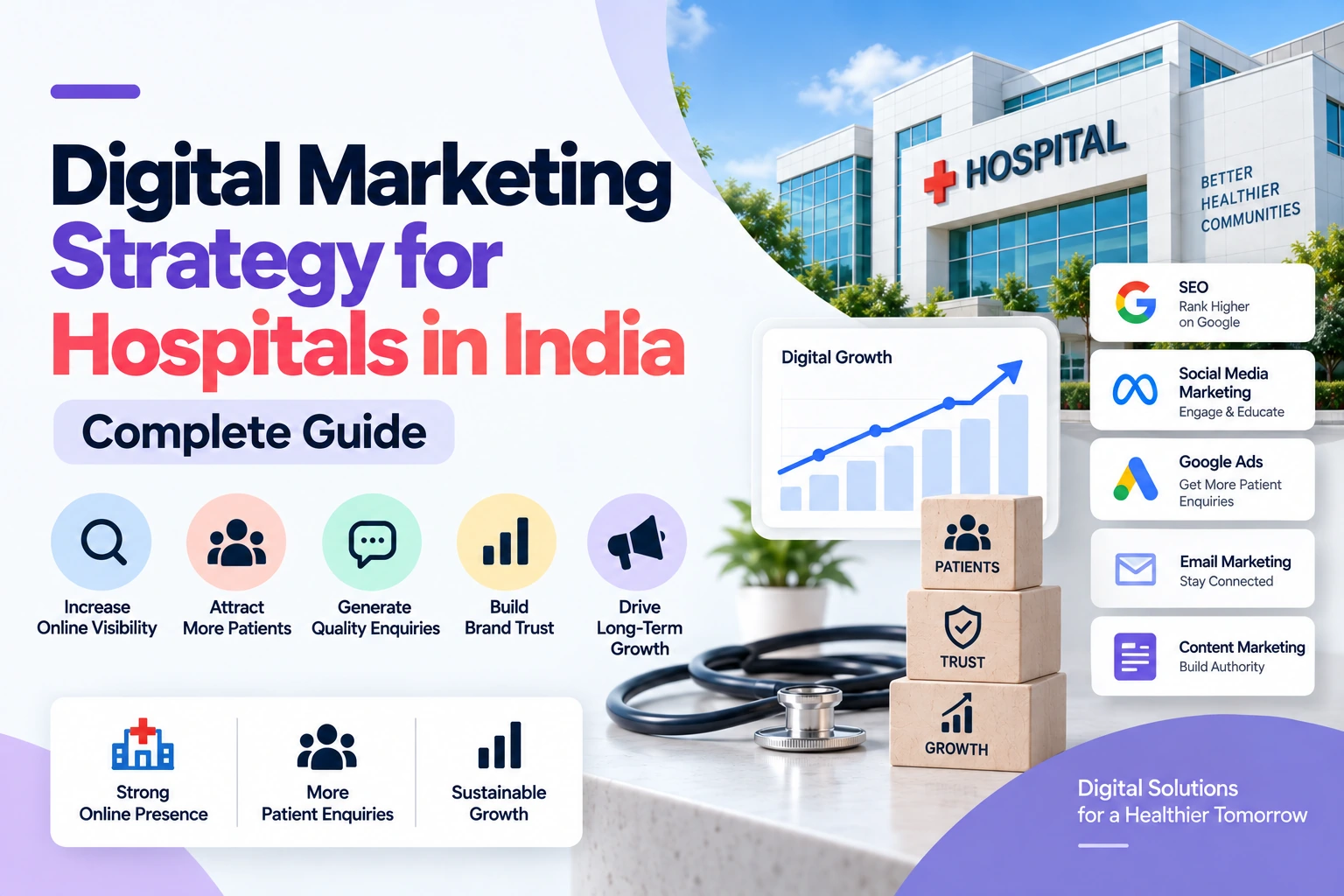
Indian hospitals that grow fastest in 2026
are not necessarily the largest, oldest, or most equipped.
They are the ones that appear first when patients search Google for their specialty,
whose doctors are trusted faces on YouTube and Instagram,
whose WhatsApp responds within minutes,
and whose reviews reassure anxious families before a critical medical decision.
Digital marketing for Indian hospitals is no longer optional —
it is the primary patient acquisition channel for every specialist, OPD, and surgical team.
This complete guide covers every digital marketing channel and strategy
that builds a dominant, trusted hospital brand in India
and consistently fills appointment books across all specialties.
Why Digital Marketing Is Now Essential for Indian Hospitals
- Search-driven patient decisions: 80%+ of Indian patients research hospital and specialist choices on Google before booking — hospitals not on page 1 are not in consideration
- Trust verification shift: Patients no longer rely solely on doctor referrals — they verify hospital quality through Google reviews, accreditation information, and specialist credentials online
- Competition intensification: New private hospitals entering every Indian city — digital visibility is now the primary competitive differentiator
- Medical tourism growth: International and out-of-city patients find hospitals exclusively through Google and online research
- Young patient demographic: Patients under 45 — growing hospital demographic — make all healthcare decisions digitally
- ROI clarity: Digital marketing provides measurable patient acquisition data — cost per enquiry, cost per admission — that traditional marketing cannot match
Channel 1 — Google Business Profile
GBP is the foundation of every hospital digital marketing strategy —
generating free patient calls and direction requests across all specialties
from patients searching Google Maps daily.
Hospital GBP Priorities
- Primary category: “Hospital” — captures all hospital local searches
- Services: every specialty department — Cardiology, Orthopaedics, Gynaecology, Neurology, Oncology, Emergency — each adds specialty search ranking signal
- Description: 750 characters covering specialties, technology, accreditations, insurance empanelments, city
- Photos: 60+ — hospital, departments, equipment, specialist doctors
- Reviews: 150+ at 4.3+ stars — systematic discharge WhatsApp review collection
- Posts: 3 to 4 per week — health awareness, specialist announcements, insurance updates, health camps
Channel 2 — Hospital Website SEO
A hospital website optimized for patient search queries
generates free, permanent traffic from high-intent specialty searches —
the highest long-term ROI channel in hospital digital marketing.
Hospital SEO Content Architecture
- Specialty department pages: Individual pages for every department — “Cardiology Hospital in [City]”, “Orthopaedics Hospital [City]” — target local specialty searches
- Procedure pages: “Knee Replacement Surgery [City]”, “Angioplasty [City]” — procedure-specific research stage patients
- Individual doctor pages: Every specialist — name searches by referred patients convert at very high rates
- Cost guide pages: “Knee replacement surgery cost India”, “IVF cost [city]” — highest intent research content
- Insurance pages: “HDFC Ergo cashless hospital [city]” — insurance-specific high-intent searches
- Symptom pages: “When to go to hospital for chest pain” — condition-driven awareness content
Hospital Blog Content for SEO
- Publish 4 specialist-authored blog posts per month — large institution content cadence
- Topics: condition awareness, procedure guides, cost information, recovery guidance, health awareness calendar
- Author attribution: every post by named specialist with MD/MS qualifications — E-E-A-T signal for medical SEO
- Hindi versions of highest-traffic posts — expands reach to non-English-searching patients
Channel 3 — Google Ads for Immediate Specialist Volume
While SEO builds over months, Google Ads delivers specialist patient enquiries
within 24 to 48 hours of campaign launch —
making it essential for new specialty launches, seasonal volume needs, and growth acceleration.
Hospital Google Ads Campaign Structure
- Cardiac Surgery: Highest procedure value — angioplasty, bypass, valve replacement searches
- Joint Replacement: Knee and hip replacement — high value, research-intensive patients
- Maternity: Normal delivery, C-section, high-risk pregnancy — location-sensitive, emotional decisions
- IVF and Fertility: High value, price-researching patients — multiple comparison searches
- Oncology: Cancer treatment, chemotherapy, oncologist searches — urgent, high-stakes
- Health Check-up: Full body health check, corporate check-up — preventive care, price-sensitive
- Emergency: 24-hour hospital, ambulance, emergency near me — immediate local conversion
Google Ads Best Practices for Hospitals
- Separate campaign per specialty — independent budget, ad copy, and landing page per specialty
- Specialty landing pages: not homepage — doctor credentials + outcomes + WhatsApp CTA per specialty
- Call extensions: click-to-call from mobile ads — emergency and urgent patients prefer calling
- Location radius: 15 to 25km from hospital — hospitals draw from wider area than clinics
- Budget: ₹500 to ₹3,000/day per specialty campaign depending on procedure value and city
- Conversion tracking: WhatsApp clicks, phone calls, and online booking tracked from day 1
Channel 4 — YouTube for Doctor Authority
YouTube is India’s second-largest search engine —
and hospital specialist doctors creating educational video content
build extraordinary patient trust and institutional authority
that no other channel can replicate.
Hospital YouTube Content Strategy
- Channel: “[Hospital Name] Health” — institutional channel for all specialist content
- Specialist series: each doctor publishes monthly — “Cardiology Q&A with Dr. [Name]”
- High-volume topics: “Signs of heart attack Indian patients ignore”, “When to see an orthopaedic surgeon”, “IVF treatment explained in Hindi”, “Understanding chemotherapy — what to expect”
- Procedure explainer videos: what happens during knee replacement, what to expect during angioplasty — reduces patient anxiety, increases booking confidence
- Patient testimonial videos: powerful trust-building content for high-stakes procedures
- Health awareness: monthly videos aligned to global health calendar — World Heart Day, Cancer Awareness Month
- Upload: 4 to 6 videos per month — institutional content cadence
Channel 5 — Facebook and Instagram for Community Trust
Facebook for Hospital Marketing
- Primary platform for 35+ demographic — significant hospital patient and family member audience
- Health awareness posts: condition education, prevention tips, seasonal health advice
- Free health camp announcements: reach and registration for community camps
- Facebook Live: specialist health talks — “Ask the Cardiologist” monthly live sessions
- Facebook Ads: target city residents 35+ with specialty awareness and health check-up offers
- Community groups: participate in local city Facebook groups with health awareness content
Instagram for Hospital Marketing
- Primary platform for 25 to 45 demographic — maternity, orthopaedics, preventive care audience
- Specialist Reels: doctors explaining conditions in 60 to 90 seconds — educational, shareable
- Behind-the-scenes: new equipment arrival, OT team, NICU milestones — humanizes institution
- Patient testimonial Reels: recovery stories, happy discharge moments — emotional trust-building
- Health awareness Reels: World Heart Day, Diabetes Day — tied to calendar events
- Posting: 5 to 6 times per week — Reels for reach, carousels for saves, Stories for engagement
Channel 6 — WhatsApp Marketing for Patient Acquisition and Retention
Patient Acquisition via WhatsApp
- WhatsApp Business: dedicated hospital number with quick replies for common OPD enquiries
- OPD booking via WhatsApp: fastest path from patient interest to confirmed appointment
- Auto-reply: acknowledges every enquiry within seconds during and outside hours
- Response protocol: all WhatsApp enquiries answered within 15 minutes — speed determines conversion
Patient Retention via WhatsApp
- Post-discharge follow-up: “How are you recovering? Do you have any questions for Dr. [Name]?” — drives review and return visit
- Annual health check-up reminder: WhatsApp broadcast to previous patients — recall marketing
- Health awareness broadcasts: monthly tips to opted-in patient list — keeps hospital top of mind
- New specialist announcement: “We now have a [specialty] specialist available on [days]” — reactivates past patients for new specialty needs
- Free camp announcements: broadcast to previous patient contacts — drives attendance and referrals
Channel 7 — Reputation Management
- Google review collection: systematic discharge WhatsApp request — 15 to 30 new reviews per month target
- Practo profile: complete hospital and individual doctor profiles — high-authority healthcare platform
- Review response: patient relations team responds to all reviews within 48 hours
- Media relations: proactive press releases for milestones, new technology, awards — builds institutional credibility and backlinks
- NABH recertification: maintain and prominently display accreditation — highest Indian hospital trust signal
- Award applications: Best Hospital in [city] awards — media coverage and credibility
Hospital Digital Marketing Budget Allocation India
Mid-Size Hospital (₹1,00,000 to ₹3,00,000/month)
- Google Ads: ₹50,000 to ₹1,50,000 — primary immediate patient volume driver
- SEO and content: ₹20,000 to ₹40,000 — specialist blog posts, website optimization
- Social media management: ₹15,000 to ₹30,000 — Facebook, Instagram, YouTube
- GBP management: ₹8,000 to ₹15,000 — posting, review management
- WhatsApp automation: ₹5,000 to ₹10,000
Large Hospital Group (₹3,00,000 to ₹10,00,000/month)
- Google Ads: ₹1,50,000 to ₹5,00,000 — multiple specialty campaigns
- SEO and content: ₹50,000 to ₹1,00,000 — comprehensive content program
- Social media: ₹40,000 to ₹80,000 — full-time social media team
- YouTube production: ₹30,000 to ₹60,000 — specialist video series
- PR and reputation: ₹30,000 to ₹60,000
- GBP and local: ₹15,000 to ₹30,000 per location
Measuring Hospital Digital Marketing ROI
- New patient enquiries per month per specialty — primary growth metric
- Cost per patient enquiry per channel — allocate budget to lowest cost channels
- Cost per new admission — true ROI metric for high-value specialties
- OPD new patient growth month-over-month — overall digital program health
- Google review velocity — reviews per month across hospital
- Organic traffic growth — Google Search Console monthly
- Google Ads ROAS — revenue per rupee spent on ads
- Patient source survey — ask every new OPD patient “How did you find us?” monthly
For the complete SEO strategy within this broader marketing approach,
see our guide on hospital SEO for Indian healthcare centres.
For the specific online enquiry generation tactics that fill appointment books,
see our guide on how hospitals generate more online enquiries in India.
Conclusion
Digital marketing for Indian hospitals in 2026 is a multi-channel investment
that rewards consistency, specialist authority, and patient-centred content
over one-time campaigns and paid shortcuts.
Hospitals building strong GBP profiles with 150+ reviews,
SEO-optimized specialty pages, Google Ads for immediate volume,
and specialist YouTube channels for long-term authority
are creating patient acquisition systems that grow independently of referrals —
compounding month after month to fill every specialty appointment book.
Call To Action
Want a complete digital marketing strategy built for your hospital?
Get a free hospital digital marketing consultation today — we build patient acquisition systems for Indian hospitals that consistently grow OPD volume and specialist appointment bookings across all departments.
Or contact us on WhatsApp to discuss your hospital’s digital marketing requirements.
Frequently Asked Questions
What is the best digital marketing strategy for hospitals in India?
The highest-ROI hospital digital marketing combination: fully optimized Google Business Profile with 150+ reviews, Google Ads targeting high-value specialty keywords (cardiac, orthopaedic, maternity), SEO specialty department and procedure pages, specialist YouTube channel with monthly educational videos, and WhatsApp Business with 15-minute enquiry response protocol. Hospitals implementing all five channels consistently report 3 to 5x increase in new online patient enquiries within 9 to 12 months.
How much should a hospital spend on digital marketing in India?
Mid-size hospitals (100 to 300 beds) should invest ₹1,00,000 to ₹3,00,000/month in digital marketing. Large hospital groups (300+ beds, multiple locations) invest ₹3,00,000 to ₹10,00,000/month. Given that a single cardiac surgery generates ₹2,00,000 to ₹10,00,000+ in revenue, most hospitals achieve 5x to 20x return on digital marketing investment within 12 months of properly implemented strategy. Measure cost per new patient admission monthly to calculate true ROI.
Is Google Ads effective for Indian hospitals?
Yes — Google Ads is the fastest and most measurable patient acquisition channel for Indian hospitals. Specialty campaigns (cardiac surgery, joint replacement, IVF, maternity) targeting high-intent procedure keywords deliver specialist enquiries within 24 to 48 hours of launch. Most Indian hospital Google Ads campaigns achieve positive ROI within 30 to 60 days when structured with specialty-specific landing pages, WhatsApp conversion tracking, and weekly optimization. Run Google Ads alongside SEO — ads provide immediate volume while SEO builds long-term free traffic.
Should hospitals invest in YouTube marketing in India?
Yes — YouTube delivers exceptional long-term value for Indian hospitals. Specialist doctor videos rank on Google Search — creating double discovery benefit. “Signs of heart attack”, “knee replacement recovery”, and “IVF treatment explained” are among the most searched Indian healthcare YouTube topics. Hospitals whose specialists publish monthly educational videos build extraordinary patient trust — patients who watch a cardiologist explain a procedure online convert to booked consultations at significantly higher rates than patients who only read website content.
How do hospitals use social media for patient acquisition in India?
Most effective hospital social media approach: Facebook for 35+ patient demographic (health awareness posts, live specialist Q&A, health camp announcements, Facebook Ads for check-up packages) and Instagram for 25 to 45 demographic (specialist Reels explaining conditions, patient recovery testimonials, hospital milestone content, behind-the-scenes of new technology). Social media builds institutional trust and awareness — converting followers to patients over 3 to 6 months of consistent content.
How long does hospital digital marketing take to show results in India?
Google Ads shows results within 24 to 48 hours. GBP optimization improves Local Pack ranking within 6 to 10 weeks. Website SEO specialty pages rank within 4 to 8 months. YouTube channel generates meaningful patient enquiries within 6 to 12 months of consistent publishing. Full integrated digital marketing strategy produces compounding results — most hospitals see 50 to 150% increase in new online patient enquiries within 12 months of consistent multi-channel implementation.
What is the most important KPI for hospital digital marketing in India?
Cost per new patient admission is the most important hospital digital marketing KPI — it measures actual revenue-generating patients, not just website visits or enquiries. Track monthly: total digital marketing spend ÷ new patients attributable to digital channels. For high-value specialties (cardiac, orthopaedic, oncology), a cost per new patient admission under ₹5,000 represents exceptional ROI. Supplement with patient source surveys (“how did you find us?”) at OPD registration for attribution across channels.
Should hospitals do digital marketing in-house or hire an agency in India?
A hybrid approach delivers best results for Indian hospitals. In-house: GBP management, WhatsApp response, social media content creation (doctors creating their own Reels performs better than agency content), and patient review collection — these require institutional knowledge and authenticity. Agency: Google Ads management and technical SEO benefit significantly from specialist expertise — poorly managed hospital Google Ads waste substantial budget. Most hospitals achieve best ROI with a dedicated in-house marketing coordinator managing channels and an agency handling paid advertising and technical SEO.