Home
Home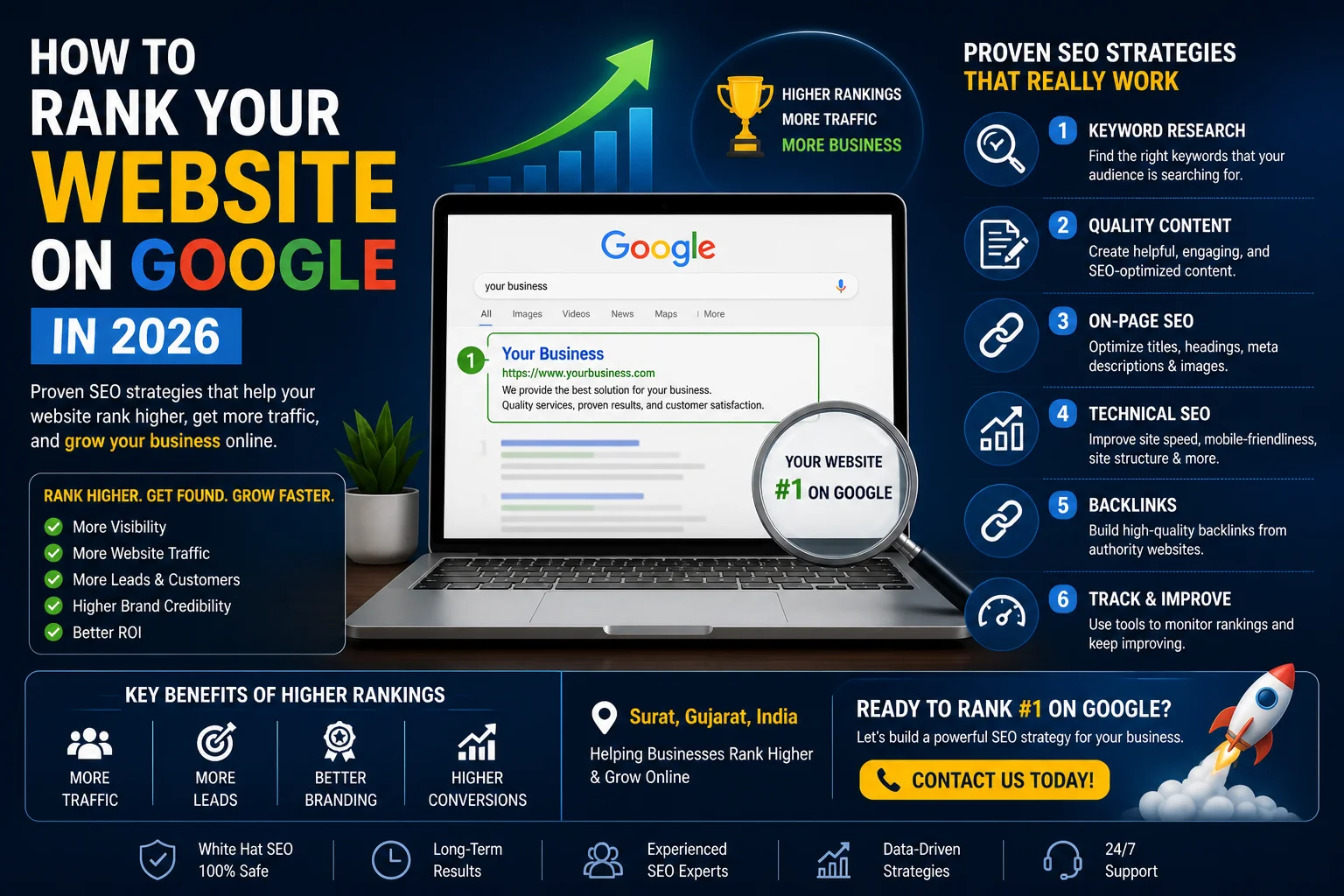
But with billions of websites competing for the top spots, how do you actually achieve high rankings in 2026? This complete guide will walk you through the exact, proven strategies that work right now — covering technical SEO, content strategy, local SEO for India, and the newest AI-era ranking factors. Whether you are a business in Surat, Gujarat, or anywhere in India, these steps will give your website the competitive edge it needs.
How Google Ranking Works in 2026
Google uses a sophisticated algorithm with over 200 ranking factors to decide which pages appear at the top of search results. In 2026, the key pillars that matter most are:
- Content quality and helpfulness — Does your content genuinely help users?
- E-E-A-T — Experience, Expertise, Authoritativeness, and Trustworthiness
- Page experience and Core Web Vitals — Is your site fast and user-friendly?
- Backlinks — Do authoritative websites link to your content?
- User engagement signals — Do visitors stay on your page and find value?
- Mobile optimization — Is your site perfectly functional on smartphones?
Understanding these pillars is the foundation of every effective SEO strategy.
Step-by-Step Guide to Rank Your Website on Google
Step 1: Keyword Research — Find What Your Audience is Searching
Keyword research is the starting point of all SEO. You need to understand the exact terms your target audience types into Google. Use tools like Google Keyword Planner (free), Ubersuggest, Ahrefs, or SEMrush to identify:
- Primary keywords: High-intent phrases like “web development company Surat” or “SEO services Gujarat”
- Long-tail keywords: More specific phrases like “affordable WordPress website development in Surat” — these are easier to rank for and often have higher conversion intent
- Local keywords: City and region-specific phrases critical for businesses serving local customers
Focus on keywords with a balance of decent search volume and manageable competition, especially when your website is new.
Step 2: On-Page SEO Optimization
On-page SEO refers to all the optimizations you make directly on your website pages. Key elements include:
- Title Tags: Include your primary keyword within the first 60 characters of the page title
- Meta Descriptions: Write compelling 155-character summaries with your keyword that encourage clicks
- H1, H2, H3 Headings: Structure your content clearly with keyword-rich headings
- URL Structure: Use short, descriptive, keyword-rich URLs (e.g., /seo-services-surat)
- Image Alt Text: Describe all images with relevant keyword-inclusive text
- Internal Linking: Link related pages within your site to distribute authority and help Google crawl your content
- Keyword Placement: Include your primary keyword naturally in the first 100 words, in at least one subheading, and throughout the content without overstuffing
Step 3: Create High-Quality, Helpful Content
Google’s Helpful Content system rewards pages that are written for people first, not for search engines. In 2026, thin, generic, or AI-spun content performs very poorly. What works is content that:
- Answers questions comprehensively and accurately
- Shows genuine expertise and real-world experience
- Is written in clear, readable language for your target audience
- Covers topics in sufficient depth (1,000–2,500+ words for competitive topics)
- Is regularly updated to stay accurate and relevant
For businesses in Surat and Gujarat, writing content that addresses local challenges, examples, and contexts will outperform generic national content for local search terms.
Step 4: Optimize Website Speed and Technical SEO
Google considers page speed and Core Web Vitals as direct ranking signals. A slow website frustrates users and ranks lower. Key technical improvements include:
- Compress and optimize all images (use WebP format where possible)
- Enable browser caching and GZIP compression on your server
- Use a Content Delivery Network (CDN) for faster loading globally
- Choose a fast, reliable hosting server (avoid cheap shared hosting)
- Minify CSS, JavaScript, and HTML files
- Ensure your website is fully mobile-responsive
- Fix broken links and crawl errors in Google Search Console
- Install an SSL certificate (HTTPS is required for ranking)
Step 5: Build High-Quality Backlinks
Backlinks — links from other websites pointing to yours — remain one of the strongest ranking signals in 2026. Not all backlinks are equal. Focus on earning links from reputable, relevant websites:
- Get listed in India-based business directories (Justdial, IndiaMart, Sulekha)
- Write guest posts for industry blogs relevant to your niche
- Create shareable resources — guides, tools, infographics — that others naturally link to
- Collaborate with local Surat and Gujarat businesses for cross-linking opportunities
- Issue press releases for newsworthy business events
- Get featured in local Gujarat news websites or industry publications
Avoid buying cheap backlinks from link farms. These can result in Google penalties that destroy your rankings.
Step 6: Local SEO for India and Surat-Based Businesses
If you serve local customers in Surat or Gujarat, local SEO is critical. Key local SEO steps include:
- Google My Business: Claim and fully optimize your Google Business Profile with accurate NAP (Name, Address, Phone), business hours, photos, and regular posts
- Local Citations: Ensure your business is listed consistently across Indian directories
- Location Pages: Create dedicated pages for each city or area you serve
- Local Schema Markup: Add LocalBusiness JSON-LD schema to your website
- Reviews: Actively request Google reviews from satisfied customers — they directly influence local rankings
Step 7: Improve User Engagement Signals
Google monitors how users interact with your website in search results. Improving these signals helps rankings:
- Write compelling meta titles and descriptions to improve click-through rates
- Ensure content matches search intent — if someone searches “how to rank on Google,” give them actionable steps, not a product pitch
- Improve page readability with clear headings, short paragraphs, and multimedia
- Reduce bounce rate by making your content immediately valuable and engaging
Step 8: Use Google Search Console and Analytics
Both tools are free and essential for monitoring and improving your SEO performance:
- Google Search Console: Monitor which keywords bring you traffic, identify crawl errors, check mobile usability, and submit sitemaps
- Google Analytics 4: Understand visitor behavior, traffic sources, conversion rates, and which content performs best
Review these dashboards at least monthly and use the data to refine your content and technical SEO strategy continuously.
SEO Mistakes That Kill Rankings
- Keyword stuffing — overusing keywords unnaturally
- Duplicate content across multiple pages
- Buying low-quality backlinks
- Ignoring mobile optimization
- Publishing thin, unhelpful content just to target keywords
- Slow loading speeds not being addressed
- Missing or poorly written meta tags
How Long Does It Take to Rank on Google?
Honest answer: SEO takes time. For new websites targeting competitive keywords, expect 3–6 months before significant rankings appear. Local and long-tail keywords in less competitive niches can rank within 4–8 weeks with focused effort. Consistent, quality content creation combined with technical optimization and steady link-building compounds over time — businesses that start SEO today will see the biggest rewards in 12–18 months.
Conclusion
Learning how to rank your website on Google in 2026 requires a combination of great content, solid technical foundations, strong backlinks, and local SEO strategies. For businesses in Surat, Gujarat, and across India, consistent SEO effort is one of the highest-ROI investments you can make. Start with keyword research, fix your on-page elements, create genuinely helpful content, and build your authority systematically. The results are worth it.
Call To Action
Want expert help ranking your website on Google? Contact us today for a comprehensive SEO audit and customized strategy for your Surat or Gujarat business.
Frequently Asked Questions
How long does it take to rank on Google?
For competitive keywords, expect 3–6 months for significant results. Local and long-tail keywords can rank within 4–8 weeks with focused SEO efforts and quality content.
What is the most important factor for ranking on Google?
Content quality and helpfulness, combined with backlinks from authoritative sources, are the most impactful ranking factors in 2026. Technical SEO and Core Web Vitals also play a significant role.
Is SEO free?
The traffic earned through organic SEO is free, but the time, content creation, and technical optimization required have real costs — either in your time or money paid to an SEO professional or agency.
Can I do SEO myself for my Surat business website?
Yes, basic on-page SEO and Google My Business optimization can be done independently. For competitive industries or faster results, working with a local Surat SEO expert is recommended.
Does social media help Google rankings?
Social media does not directly influence Google rankings, but it helps distribute your content, drive traffic to your website, and build brand awareness — all of which indirectly support your SEO performance.