Home
Home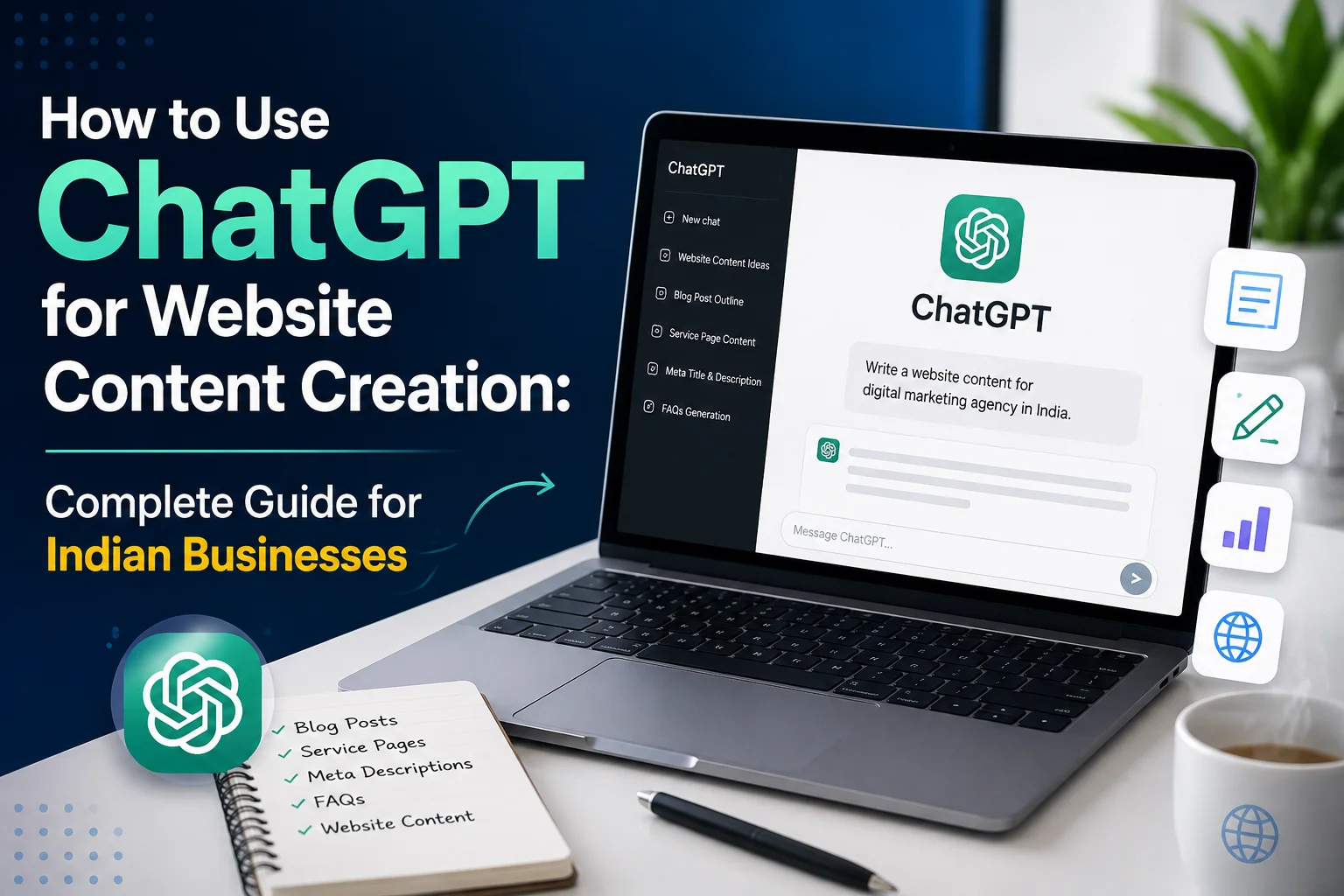
Indian business owners are discovering that ChatGPT can dramatically reduce the time
and cost of creating website content — blog posts, service page copy, FAQs,
meta descriptions, and more.
But there is a significant difference between using ChatGPT correctly and using it poorly.
Used correctly — ChatGPT accelerates your content production, maintains quality,
and helps you publish more consistently.
Used poorly — it produces generic, repetitive content that Google penalizes
and that fails to convert Indian visitors into customers.
This complete guide shows Indian businesses and web designers exactly how to use ChatGPT
for website content creation in 2026 — with specific prompts, best practices, and honest limitations.
What ChatGPT Can and Cannot Do for Indian Business Content
What ChatGPT Does Well
- Drafting first versions of blog posts, service pages, and FAQs quickly
- Generating multiple headline and meta description options
- Rewriting existing content to improve clarity and flow
- Suggesting blog topic ideas based on your niche and target audience
- Creating content outlines and section structures before writing
- Translating or adapting content for different Indian audiences
- Generating FAQ questions your Indian customers would ask
What ChatGPT Does Poorly
- Providing accurate India-specific pricing, statistics, or market data — it may hallucinate numbers
- Writing in your personal voice without extensive examples and guidance
- Creating genuinely original insights from real client experience
- Understanding Surat-specific local context without detailed prompting
- Generating content that passes Google’s Helpful Content evaluation when published without human review and enhancement
The Right Way to Use ChatGPT for Indian Business Content
The most effective approach is to use ChatGPT as a first-draft accelerator —
not as a finished content publisher.
Every piece of ChatGPT output should be reviewed, edited, and enhanced
with your genuine expertise, India-specific data, and personal experience before publishing.
- ChatGPT writes the structure and draft — you add the expertise and local context
- ChatGPT suggests ideas — you validate them against real Indian market knowledge
- ChatGPT produces 70% of the work — you add the 30% that makes it genuinely valuable
10 Practical ChatGPT Prompts for Indian Business Website Content
Prompt 1: Blog Post Draft
Use this to generate a complete blog post draft:
“Write a 1500-word blog post titled ‘[Your Title]’ for Indian small business owners. The target audience is business owners in Surat, Gujarat who want to [achieve goal]. Include: an introduction explaining the problem, 6 to 8 main sections with H2 headings, bullet points for key steps, India-specific examples where possible, and a conclusion with a call to action. Write in a clear, professional but conversational tone. Avoid generic filler — be specific and actionable throughout.”
Prompt 2: Service Page Copy
“Write a service page for a WordPress developer in Surat offering [service name]. Include: a headline targeting Indian small businesses, 3 to 4 paragraphs explaining the service and its benefits, a bullet list of what is included, a section on why choose a local Surat developer, starting price range of ₹[X] to ₹[Y], and a call to action to get a free quote via WhatsApp. Keep it professional and conversion-focused.”
Prompt 3: FAQ Section
“Generate 8 FAQ questions and detailed answers for a blog post about [topic] targeting Indian business owners. Questions should be the exact phrases Indian customers would type into Google or ask on WhatsApp. Answers should be 2 to 4 sentences each — complete but concise. Include India-specific context, rupee pricing where relevant, and practical actionable answers.”
Prompt 4: Meta Titles and Descriptions
“Write 5 meta title options and 5 meta description options for a blog post about [topic] targeting Indian businesses in 2026. Meta titles must be under 60 characters and include the primary keyword. Meta descriptions must be under 160 characters, include the keyword, and have a clear benefit statement that encourages clicks from Indian users.”
Prompt 5: Blog Topic Ideas
“Generate 20 blog post topic ideas for a WordPress developer and web designer based in Surat, Gujarat, India. Target audience: Indian small and medium businesses wanting to improve their online presence. Topics should target keywords Indian business owners search for in Google. Avoid topics already covered: [list your existing blog titles]. Each idea should include a suggested title and target keyword.”
Prompt 6: Rewrite for SEO
“Rewrite the following content to improve SEO and readability for an Indian audience. Target keyword: [keyword]. Requirements: include keyword in first paragraph naturally, use shorter sentences, add bullet points for any list items, improve the FAQ section to directly answer questions, and ensure the content reads naturally — not like it was written for a search engine. Here is the original content: [paste content]”
Prompt 7: WhatsApp Message Templates
“Write 5 WhatsApp message templates for a Surat web designer to send to potential clients after they fill a contact form. Each message should: be warm and professional, reference their specific inquiry if possible, offer a free consultation, and include a clear next step. Keep each message under 100 words. Write in a natural Indian business communication style.”
Prompt 8: Google Business Profile Post
“Write 4 Google Business Profile post drafts for a WordPress developer in Surat. Post types: 1) Recent project highlight, 2) SEO tip for Indian businesses, 3) Website maintenance reminder, 4) New service announcement. Each post should be 100 to 150 words, include a call to action, and be written for Surat business owners. Use clear, accessible language.”
Prompt 9: Testimonial Request Message
“Write a WhatsApp message to send to a client after completing their WordPress website project, asking for a Google review. The message should: thank them for their business, mention the specific project briefly, explain the importance of reviews, provide the review link [your link], and make it easy for them to write a specific review by suggesting they mention the type of website and their experience. Keep it under 80 words and natural in tone.”
Prompt 10: Content Outline
“Create a detailed content outline for a comprehensive blog post titled ‘[Title]’ targeting Indian business owners. Include: suggested word count for each section, key points to cover in each section, sub-headings (H3) within major sections, suggested data or statistics to research and include, and 6 FAQ questions to add at the end. The post should comprehensively cover the topic for Indian businesses in 2026.”
How to Make ChatGPT Content India-Specific
Generic ChatGPT output often lacks the India-specific context that makes content
genuinely useful for Indian audiences and rankable for Indian search queries.
- Always specify “for Indian businesses” or “for Surat businesses” in your prompts
- Add “include rupee pricing” — ChatGPT defaults to dollar amounts without instruction
- Add “mention Indian tools like Razorpay, Justdial, Rank Math” where relevant
- Specify “Indian mobile users on 4G connections” for website performance content
- After generating — manually add your own Surat-specific examples and client references
- Replace any generic statistics with India-specific data you verify from reliable sources
ChatGPT Content Quality Checklist Before Publishing
Before publishing any ChatGPT-generated content on your Indian business website:
- Read every paragraph — remove any generic filler sentences that add no value
- Verify any statistics or data points — ChatGPT can hallucinate specific numbers
- Add at least 3 to 5 specific examples from your own Surat client experience
- Replace global pricing with India-specific rupee amounts you can verify
- Add your personal opinion or professional recommendation in at least 2 places
- Ensure the introduction addresses the specific problem your Indian reader has
- Check that the CTA directs to your WhatsApp or quote page specifically
- Run through Rank Math SEO — ensure keyword density, meta tags, and schema are set
Will Google Penalize ChatGPT Content?
Google’s official position in 2026: AI-generated content is acceptable if it is helpful,
accurate, and created for users — not to manipulate search rankings.
Google penalizes low-quality, spammy AI content — not AI content that genuinely helps readers.
- Thin ChatGPT content published without human review = risk of Helpful Content penalty
- ChatGPT draft + human expertise + India-specific data + genuine review = acceptable and rankable
- The test is not “was AI used?” — the test is “is this genuinely helpful for the Indian reader?”
Conclusion
ChatGPT is the most powerful content creation tool available to Indian businesses in 2026 —
but it is a tool, not a replacement for genuine expertise and local knowledge.
Used as a first-draft accelerator with strong human editing, India-specific enhancement,
and your personal professional experience added throughout —
it dramatically reduces content creation time while maintaining quality that ranks and converts.
Start with the 10 prompts in this guide. Use them this week for your next blog post.
Experience the difference between unedited AI output and expertly enhanced AI-assisted content.
The Indian businesses publishing consistent, high-quality content in 2026
will be the ones dominating their niche search results in 2027.
Call To Action
Need help creating a consistent content strategy for your Surat business website?
Get a free content consultation today — we build content plans that generate leads for Indian businesses.
Or contact us on WhatsApp to discuss your website content strategy.
Frequently Asked Questions
Can Indian businesses use ChatGPT to write their website content?
Yes — but with important caveats. ChatGPT-generated content must be reviewed, edited,
and enhanced with India-specific data, personal expertise, and real client examples
before publishing. Published without human enhancement, AI content risks Google penalties.
Will Google penalize my Indian business website for using ChatGPT content?
Google penalizes low-quality, unhelpful AI content — not AI-assisted content that genuinely helps readers.
ChatGPT content that is reviewed, enhanced with expertise, and genuinely useful
for Indian readers is acceptable and can rank well in Google search results.
How do I make ChatGPT content India-specific?
Always specify “for Indian businesses” or “for Surat businesses” in prompts.
Request rupee pricing, Indian tool references, and Indian market context.
After generating — manually add your own client examples, verified Indian statistics, and local context.
What is the best way to use ChatGPT for blog posts as an Indian web designer?
Use ChatGPT to create the outline and first draft, then spend 30 to 45 minutes enhancing it
with your professional experience, specific Surat client examples, verified data, and personal recommendations.
This hybrid approach produces better content faster than writing from scratch or publishing AI output directly.
How much time does ChatGPT save for Indian business content creation?
A 1,500-word blog post that takes 3 to 4 hours to write from scratch takes 45 to 90 minutes
with ChatGPT as a first-draft accelerator — including prompting, reviewing, and enhancing.
This time saving allows Indian businesses to publish content 2 to 3 times more frequently.
Are there free ChatGPT alternatives Indian businesses can use for content?
Yes — ChatGPT free version (GPT-4o mini), Google Gemini free tier, and Microsoft Copilot
are all available to Indian users at no cost. ChatGPT Plus (₹1,650/month) provides access
to GPT-4o which produces noticeably better content for complex business topics.