Home
Home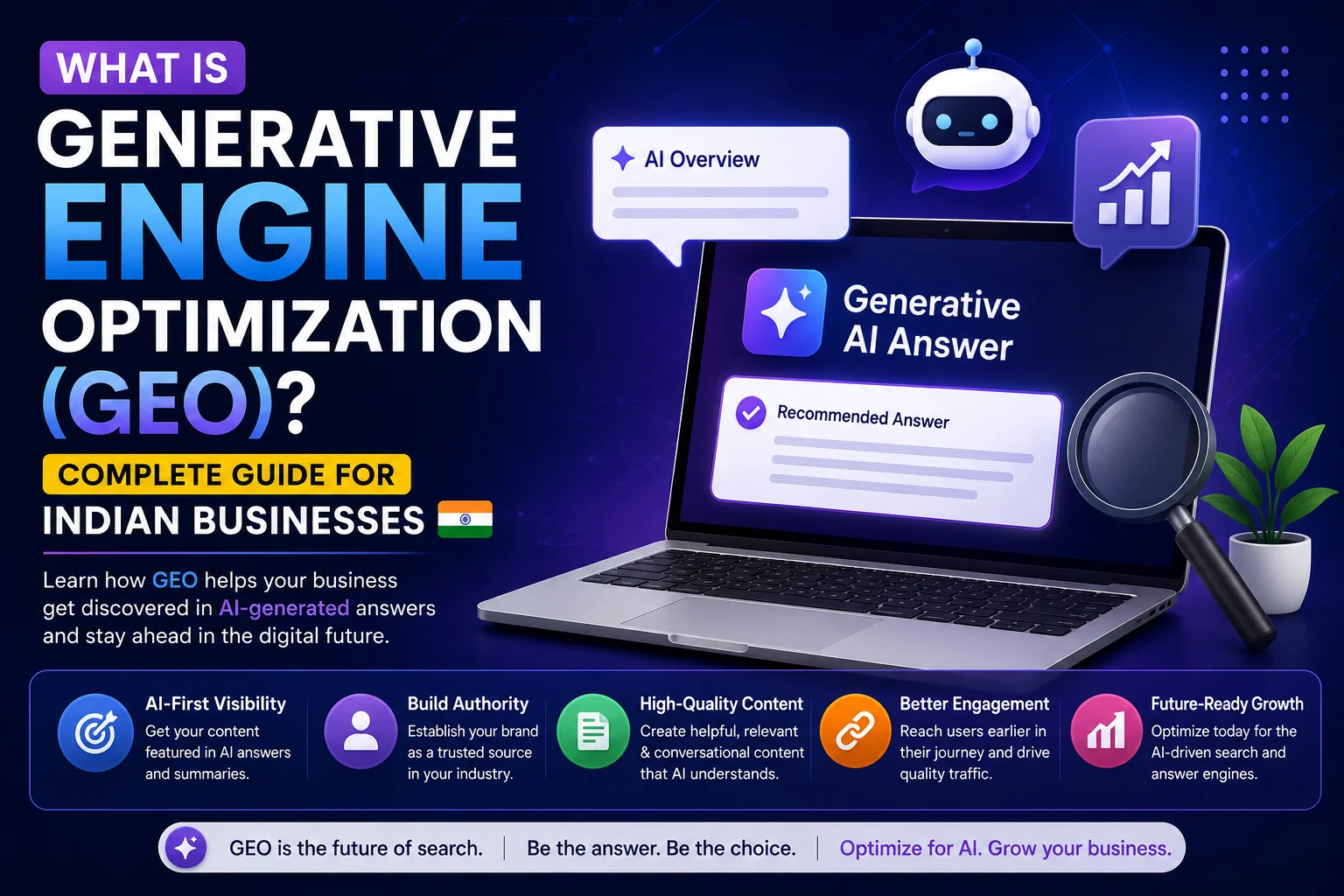
SEO you know. AEO you may have heard of.
But now there is a third term that every Indian business owner and web professional
needs to understand in 2026: GEO — Generative Engine Optimization.
GEO is not just another marketing buzzword.
It represents a fundamental shift in how AI systems find, process, and present information —
and how Indian businesses need to structure their online presence to remain visible
in an increasingly AI-driven search landscape.
This complete guide explains exactly what GEO is, how it differs from SEO and AEO,
and what Indian businesses can do today to optimize for generative AI engines.
What Is a Generative Engine?
A generative engine is an AI system that creates new content — answers, summaries, explanations —
by drawing on information from multiple sources rather than simply retrieving and displaying existing pages.
- Traditional search engine (Google 2020): Shows you a list of pages → you click one → you read the answer
- Generative engine (Google 2026, ChatGPT, Perplexity): Reads multiple pages → generates a new answer combining information → shows you the answer directly
Examples of generative engines currently used by Indian audiences:
- Google AI Overview — appears at the top of Google results for millions of queries
- ChatGPT with web browsing — answers questions using real-time web information
- Perplexity AI — AI-native search engine with citations from web sources
- Microsoft Copilot — integrated into Bing search and Microsoft products
- Google Gemini — Google’s AI assistant that answers questions with web citations
What Is Generative Engine Optimization (GEO)?
Generative Engine Optimization (GEO) is the practice of optimizing your website content
specifically to be understood, selected, and cited by generative AI engines
when they create answers to user queries.
- GEO goal: Become the source that AI engines cite when answering questions in your niche
- GEO method: Structure content for AI comprehension, demonstrate authority, provide citable facts
- GEO result: Your brand, data, or expertise appears in AI-generated answers across multiple platforms
- GEO metric: Citation frequency in AI answers, brand mentions in AI responses
The term was formally introduced in research published in 2023 and has gained significant traction
among digital marketers and SEO professionals globally — including in India — throughout 2024 and 2025.
GEO vs SEO vs AEO: What Is the Difference?
- SEO (Search Engine Optimization): Optimize pages to rank in traditional search results. Target: Google’s 10 blue links. Success = clicks to your website.
- AEO (Answer Engine Optimization): Optimize content to appear in direct answer boxes — featured snippets, People Also Ask, voice search results. Target: position zero and answer boxes.
- GEO (Generative Engine Optimization): Optimize content to be cited by AI systems that generate new answers from multiple sources. Target: ChatGPT, Perplexity, Google AI Overview citations.
In practice — all three work together.
The content optimizations for GEO improve AEO performance, which improves SEO rankings.
They are not competing strategies — they are layers of the same content excellence approach.
Why GEO Matters for Indian Businesses in 2026
India is one of the fastest-growing markets for AI tool adoption globally.
- ChatGPT usage in India grew by over 300% between 2023 and 2025
- Google AI Overviews are now shown for a significant percentage of Indian searches
- Indian professionals in IT, finance, consulting, and business increasingly use Perplexity and Gemini for research
- B2B decision-makers in India regularly use AI tools to research vendors, costs, and services before making contact
When an Indian entrepreneur asks ChatGPT “who are the most reliable WordPress developers in Surat?” —
the businesses whose content has been optimized for GEO have a chance of being cited.
Businesses that have not optimized for GEO are invisible in this increasingly important channel.
How Generative AI Engines Select Content to Cite
Understanding how AI engines decide which sources to use is the foundation of effective GEO.
1. Authority and Trustworthiness
- AI engines prefer sources with demonstrated expertise — established websites, professional credentials, detailed original content
- A website with 50 well-researched blog posts on WordPress development is more likely to be cited than one with 5 thin pages
- Author credentials, business history, and client proof increase perceived authority
2. Content Structure and Clarity
- AI systems parse structured content more effectively than walls of text
- Clear headings, bullet points, numbered steps, and tables make information extraction easier
- Direct, concise answers to specific questions are preferred over long preambles
3. Factual Specificity
- AI engines prefer content with specific, verifiable facts over vague generalizations
- Specific prices (₹20,000), timelines (4 weeks), statistics (78% of Indian users) are more citable than general statements
- Original data, case studies, and research are particularly valuable for GEO
4. Freshness and Relevance
- AI engines with web browsing capabilities prefer recently updated content
- Content updated in 2025 or 2026 is preferred over identical content from 2020
- Regular publishing signals that your website is actively maintained and current
7 GEO Strategies for Indian Businesses
1. Create Definitive Resource Pages
AI engines love comprehensive, authoritative pages that cover a topic completely.
For your Indian business — create the most complete resource on your specific niche topic.
- For a Surat web designer: the most complete guide to website development costs in Surat
- For an SEO agency: the most comprehensive local SEO guide for Indian businesses
- Cover every angle: what, why, how, how much, common mistakes, best practices, FAQs
- Update these definitive pages quarterly with fresh data and current information
2. Include Original Data and India-Specific Statistics
Original data is one of the most powerful GEO signals.
AI engines actively seek out specific statistics and data points to include in generated answers.
- Share your own project data: “In our experience with 50+ Surat business websites, average project duration is 3 to 4 weeks”
- Reference India-specific market data with sources
- Include pricing benchmarks specific to your market — generic global numbers are less useful
- Create annual reports or original research that no other source provides
3. Use Quotable Statements and Definitions
AI engines often look for clear, authoritative definitions and quotable statements
to include in generated answers.
- Define key terms in your field clearly and concisely at the start of relevant sections
- Write summary sentences that stand alone as complete, quotable thoughts
- Create clear comparisons: “GEO differs from SEO in three key ways: [list]”
- Use bold text to highlight key statements that represent your main points
4. Build Entity Authority
AI systems understand the world in terms of entities — people, businesses, places, concepts.
Establishing your business as a recognized entity in your niche improves GEO citation likelihood.
- Create a detailed About page with your name, credentials, location (Surat), and expertise
- Ensure your business information is consistent across Google Business Profile, LinkedIn, Justdial, and your website
- Get mentioned by other credible Indian websites and publications in your field
- Use your full name consistently as author on every blog post
5. Optimize for Conversational Queries
Generative engines answer conversational questions — not keyword fragments.
Indian users increasingly ask AI tools full questions in natural language.
- Create content that answers questions the way someone would actually ask them
- “How much does a professional website cost for a small business in Surat?” — not just “website cost Surat”
- Structure headings as questions your target Indian customers would ask AI tools
- Answer follow-up questions: if someone asks about cost, also cover payment terms, what is included, and hidden fees
6. Implement Comprehensive Schema Markup
Schema markup is structured data that explicitly communicates information to AI systems
in a language they understand natively.
- Organization schema — your business name, location in Surat, contact information, founding date
- Person schema — your professional credentials, expertise, and social profiles
- FAQ schema on every question-answer section
- Article schema with author, publish date, and modification date on every blog post
- Service schema — what services you offer, where, and at what price range
7. Create Content That Answers “What,” “Why,” “How,” and “How Much”
Generative engines receive all four types of questions about any given topic.
Comprehensive GEO coverage means having excellent content for all four query types.
- “What is WordPress?” — definitional content
- “Why do Surat businesses need a professional website?” — rationale content
- “How to choose a web designer in Surat?” — process content
- “How much does website development cost in Surat?” — pricing content
Common GEO Mistakes Indian Businesses Make
- Waiting for GEO to become mainstream before starting — AI citation patterns are being established now, 2026 is early mover time
- Creating thin content and expecting AI citation — GEO rewards depth and specificity, not volume of posts
- Ignoring author credentials and entity signals — AI systems value known experts more than anonymous content
- No schema markup — missing the most direct communication channel with AI engines
- Writing only for keywords — GEO requires writing for questions and providing complete answers
Pros and Cons of GEO for Indian Businesses
Pros
- Brand visibility in AI answers — reaching Indian users at the research stage before they visit any website
- Early mover advantage — most Indian competitors are not yet implementing GEO
- GEO improvements also enhance traditional SEO and AEO performance
- Builds long-term authority that compounds over time
Cons
- Harder to measure than traditional SEO — no standardized GEO analytics yet
- AI citation does not always drive direct website traffic
- AI engines update their models regularly — citation patterns can shift
Conclusion
Generative Engine Optimization is not the future of search — it is the present.
Indian users are already using ChatGPT, Perplexity, Google Gemini, and Google AI Overview
to research services, compare prices, and evaluate businesses before making contact.
The Indian businesses that start implementing GEO strategies today —
comprehensive content, specific data, clear structure, entity signals, and schema markup —
will be the ones cited as authoritative sources across all AI platforms in 2026 and beyond.
The window for early mover advantage in Indian GEO is open right now.
Call To Action
Want your Surat business website optimized for GEO, AEO, and traditional SEO in 2026?
Get a free content strategy consultation today — we build comprehensive strategies across all search formats.
Or contact us on WhatsApp to discuss your GEO optimization plan.
Frequently Asked Questions
What does GEO stand for in digital marketing?
GEO stands for Generative Engine Optimization — the practice of optimizing website content
to be cited and referenced by AI-powered generative engines like ChatGPT, Perplexity AI,
Google AI Overview, and Microsoft Copilot when they generate answers to user queries.
Is GEO replacing SEO for Indian businesses?
No — GEO is adding a new layer to existing search optimization, not replacing SEO.
Traditional Google organic rankings still drive the majority of website traffic for Indian businesses.
GEO optimizations complement SEO by making content more citable across AI platforms simultaneously.
How is GEO different from AEO for Indian websites?
AEO focuses on appearing in traditional answer formats — featured snippets and People Also Ask boxes
within existing Google search results. GEO focuses on being cited by AI systems that generate
entirely new answers from multiple sources — like ChatGPT, Perplexity, and Google AI Overview.
Do small Indian businesses need to worry about GEO?
Yes — especially local service businesses in cities like Surat. Indian B2B buyers and professionals
increasingly use AI tools to research local service providers before making contact.
A local web designer or consultant in Surat being cited in AI answers reaches exactly their target audience.
How quickly can GEO changes show results for Indian websites?
Structural changes like adding schema markup and improving content organization can result
in AI citations within 4 to 8 weeks. Building the topical authority and entity recognition
required for broader GEO citation typically takes 3 to 6 months of consistent content development.
What is the most important GEO factor for Indian business websites?
Content specificity with India-relevant data is the most impactful GEO factor for Indian businesses.
AI engines serving Indian users specifically seek out Indian market data — prices in rupees,
India-specific timelines, local examples, and regionally relevant context that global content lacks.