Home
Home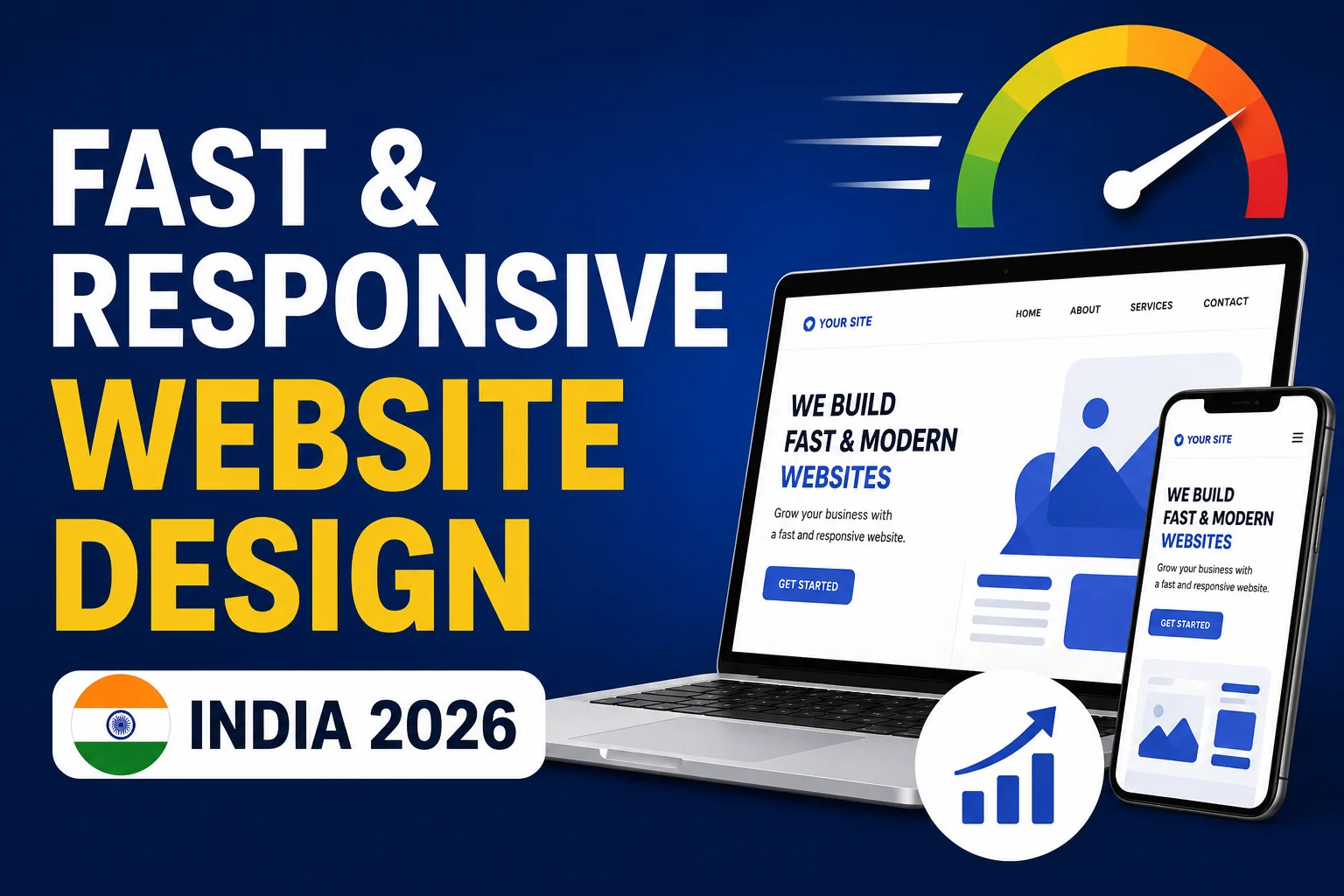
You have 3 seconds.
That is how long an Indian mobile user will wait for your website to load before leaving — permanently.
53% of visitors abandon a site that takes more than 3 seconds to load.
And if your website is not responsive — meaning it does not work properly on a smartphone —
you are invisible to 78% of India’s internet users who browse exclusively on mobile.
Fast and responsive website design is not a luxury feature for Indian businesses in 2026.
It is the foundation of every successful website — the difference between a website that generates leads
and one that loses customers before they even read a single word.
What is Responsive Website Design?
Responsive website design means your website automatically adapts its layout, font sizes, images,
and navigation to fit perfectly on any screen size — desktop, laptop, tablet, or smartphone.
- A responsive website looks and works perfectly on a 6-inch Android phone and a 27-inch desktop monitor
- No horizontal scrolling, no tiny unreadable text, no broken layouts on any device
- Buttons are sized correctly for touch — no accidental clicks or missed taps
- Images resize and crop intelligently — never stretched or cut off awkwardly
- Navigation transforms into a mobile-friendly menu — typically a hamburger icon on small screens
In India, responsive design is not optional — it is mandatory.
Google uses mobile-first indexing, meaning it ranks your website based on how it performs on mobile.
A website that looks perfect on desktop but breaks on mobile will rank lower than a mobile-optimized competitor.
What is Website Speed and Why Does It Affect Your Business?
Website speed is how fast your pages load for visitors — measured in seconds.
Google measures speed through Core Web Vitals — a set of specific performance metrics
that directly affect your search ranking position.
- LCP (Largest Contentful Paint): How fast your main content loads — target under 2.5 seconds
- INP (Interaction to Next Paint): How quickly your page responds to user interaction — target under 200ms
- CLS (Cumulative Layout Shift): How stable your page is — elements must not shift while loading
Every 1-second improvement in loading speed increases conversions by 7%.
For an Indian business website getting 1,000 visitors per month —
improving from 5 seconds to 2 seconds loading speed can mean 30 to 50 additional leads per month
from the same traffic — without spending anything extra on advertising.
Why Fast Responsive Design is Critical for Indian Websites Specifically
India’s Mobile-First Reality
- 78% of Indian internet users browse exclusively on smartphones
- India’s average mobile internet speed varies widely — 4G in cities, 3G or slower in rural areas
- A website that loads in 2 seconds on Mumbai fiber may take 8 seconds on 3G in a tier-2 city
- Indian customers judge business credibility based on website professionalism — a broken mobile layout signals an unprofessional business
- Google’s mobile-first index means your mobile performance directly determines your ranking for all searches — not just mobile searches
Competition for Indian Customers
When an Indian customer searches for your service, they typically check 3 to 5 websites before deciding.
If your website loads slowly while a competitor’s loads instantly —
the competitor gets the inquiry, the call, and the sale.
Speed is a competitive advantage that most Indian small businesses are ignoring entirely.
Key Elements of a Fast, Responsive Website Design
1. Mobile-First Design Approach
Mobile-first design means designing the mobile version of your website first —
then scaling up to tablet and desktop — rather than designing desktop first and shrinking down.
- Every section is designed to work on a 375px wide screen before anything else
- Font sizes are readable without zooming — minimum 16px body text
- CTA buttons are minimum 48px height — large enough for comfortable thumb tapping
- Phone numbers are click-to-call — one tap connects the customer
- WhatsApp button is prominently visible on mobile — most Indian customers prefer WhatsApp contact
- Forms are simplified for mobile keyboard input — fewer fields, larger input boxes
2. Lightweight, Clean Code
Bloated code is one of the most common causes of slow Indian websites.
Every unnecessary line of CSS, JavaScript, or HTML adds loading time.
A well-built website loads only the code that each specific page actually needs — nothing more.
- Custom themes contain only the features the website actually uses — no unused plugin overhead
- CSS is minified — unnecessary spaces and comments removed, file size reduced by 30 to 60%
- JavaScript is deferred — scripts load after the visible page content, not before
- Unused plugin scripts are disabled on pages where those plugins are not active
- Google Fonts are loaded locally — eliminates external DNS lookup delays
3. Optimized Images Throughout
Images are the single biggest contributor to slow page loading times on Indian websites.
Most businesses upload high-resolution photos straight from their camera — 4 to 8 MB each —
and wonder why their website loads slowly.
- All images converted to WebP format — 50 to 70% smaller than PNG or JPG with identical quality
- Images resized to the exact dimensions they display at — no downloading a 4000px image to show at 800px
- Lazy loading implemented — images below the visible area load only when the user scrolls to them
- Hero section images specially optimized — they are the first thing that loads and affects LCP score directly
- Correct image compression settings — sharp enough to look professional, small enough to load fast
4. Quality Hosting and CDN
Even perfect code and optimized images cannot overcome slow hosting.
The physical distance between your server and your visitor adds measurable loading delay.
- Hosting with servers in Mumbai or Singapore — physically closest to Indian visitors
- Cloudflare CDN — distributes your website files across servers in multiple Indian cities
- LiteSpeed web server technology — significantly faster than traditional Apache servers
- Server-side caching — pages pre-built and served instantly without database queries
5. Caching Configuration
Caching saves a static copy of your web pages so they load instantly
without rebuilding from the database on every visit.
- Page caching — full pages served as static files — dramatically reduces server processing time
- Browser caching — returning visitors load your site from their device cache — even faster
- Object caching — database queries cached — reduces database load for high-traffic pages
- WP Rocket or LiteSpeed Cache configured correctly for your specific website setup
6. Clean, Consistent Visual Design
Speed and design quality are not trade-offs — a well-designed website can be both beautiful and fast.
The key is design discipline — every visual element must earn its place by adding value to the user experience.
- Consistent spacing — equal padding and margins throughout create visual harmony
- Limited color palette — maximum 3 brand colors used consistently across all pages
- 2 font families maximum — heading font and body font — never more
- Clear visual hierarchy — most important content largest, secondary content smaller
- Ample white space — breathing room between sections improves readability significantly
- High contrast text — readable on both bright sunlight screens and dark mode devices
How We Build Fast, Responsive Websites for Indian Businesses
Every website we build follows a consistent process designed to deliver the best possible
speed, responsiveness, and user experience for Indian audiences:
- Discovery: Understanding your business, target audience, and conversion goals before touching any design
- Mobile wireframe first: Designing the mobile layout before desktop — ensuring the primary experience is perfect on small screens
- Custom design: Unique layouts built for your specific brand — not adapted from generic templates
- WordPress + Elementor or custom theme development: Clean, semantic HTML with properly structured CSS
- Performance optimization: Images compressed, caching configured, CDN connected, Google Fonts localized
- Cross-device testing: Tested on 5+ real mobile devices, not just browser simulation
- Speed validation: 90+ PageSpeed score on mobile confirmed before delivery
- SEO setup: Rank Math configured, sitemap submitted, Search Console connected
What a Fast Responsive Website Achieves for Your Indian Business
- Higher Google Rankings: Core Web Vitals are a direct ranking factor — faster sites rank above slower competitors
- Lower Bounce Rate: Visitors stay longer on fast websites — more time to read, trust, and convert
- More Leads: Every second of speed improvement increases contact form submissions and calls
- Better Mobile Experience: 78% of your visitors are on mobile — a perfect mobile layout converts them
- Professional Brand Impression: A fast, polished website signals business quality before a single word is read
- Competitive Advantage: Most Indian SMB websites are slow — a fast site immediately stands out
Common Mistakes That Make Indian Websites Slow and Non-Responsive
- Uploading original camera photos without compression — 5MB images on a business website is not acceptable
- Using heavy multipurpose themes with 200 features when 10 are needed — unused code loads anyway
- Installing 30+ plugins without checking each one’s performance impact
- Designing only on desktop and assuming mobile will look fine — it almost never does without specific attention
- Using cheap shared hosting with servers in the USA — 200ms of extra latency for every Indian visitor
- No caching plugin — every page request rebuilds from database, massively slowing down the site
- Embedding YouTube videos directly on the page — use facade loading to prevent YouTube from slowing your page
Pros and Cons
Pros of Fast Responsive Website Design
- Higher Google rankings through improved Core Web Vitals scores
- More leads from the same traffic — better conversion rate
- Works perfectly for India’s 78% mobile-browsing audience
- Professional brand impression that builds instant trust
- Future-proof — works on every device size from smartwatches to large monitors
Cons of Cutting Corners on Speed and Responsiveness
- Lower Google ranking — slow sites lose visibility over time as Google’s algorithm updates continue
- Lost leads — every second of extra loading time costs real business
- Poor mobile experience — frustrates 78% of your visitors
- Higher bounce rate — visitors leave before seeing your services or contacting you
Conclusion
A fast, responsive website is not a premium add-on for Indian businesses in 2026 — it is the baseline requirement.
Every website we build is designed mobile-first, optimized for speed, and tested to achieve
90+ PageSpeed scores before it goes live.
Your website should be working for your business every hour of every day —
loading instantly for Indian mobile users, ranking well on Google, and converting visitors into leads.
That only happens when speed and responsive design are built in from the very first line of code.
Call To Action
Want a fast, responsive website that works perfectly on every device and ranks well on Google?
Get a free website consultation today — we build mobile-first, performance-optimized WordPress websites for Indian businesses.
Or contact us on WhatsApp to discuss your project.
Frequently Asked Questions
What is the difference between a responsive website and a mobile-friendly website?
A mobile-friendly website works on mobile without breaking — minimum acceptable standard.
A responsive website is specifically designed for each screen size — mobile, tablet, and desktop —
with layouts, font sizes, and interactions optimized for each device type.
Responsive design delivers a significantly better user experience than simply “not breaking” on mobile.
How fast should a website load for Indian users?
Target under 3 seconds for full page load on a 4G mobile connection.
Google’s Core Web Vitals target is under 2.5 seconds for LCP (Largest Contentful Paint).
Achieving 90+ on Google PageSpeed Insights mobile score is the professional standard
for any Indian business website in 2026.
Does website speed really affect Google rankings in India?
Yes — directly. Google officially uses Core Web Vitals as a ranking factor.
A website with excellent speed scores ranks higher than an equivalent website with poor speed scores,
all other factors being equal. For competitive Indian local search keywords,
speed can be the differentiating factor between Page 1 and Page 2 rankings.
How much does a fast responsive website cost in India?
A professionally built, fast, responsive business website in India typically costs ₹20,000 to ₹60,000 one-time.
This includes custom design, WordPress development, speed optimization, SEO setup,
and mobile testing across multiple devices. Hosting and domain are additional annual costs.
Can my existing slow website be made faster without rebuilding it?
Yes — in many cases, significant speed improvements can be achieved on an existing website
without a full rebuild. Installing a caching plugin, compressing all images to WebP,
connecting Cloudflare CDN, and optimizing your hosting configuration can improve
PageSpeed scores by 20 to 40 points in many cases.
How do I test if my website is responsive?
The fastest test: open your website on your own smartphone and navigate every page.
For a more thorough check, use Google’s Mobile-Friendly Test at search.google.com/test/mobile-friendly.
Also check Google Search Console → Mobile Usability report — it flags specific pages with mobile issues.