Home
Home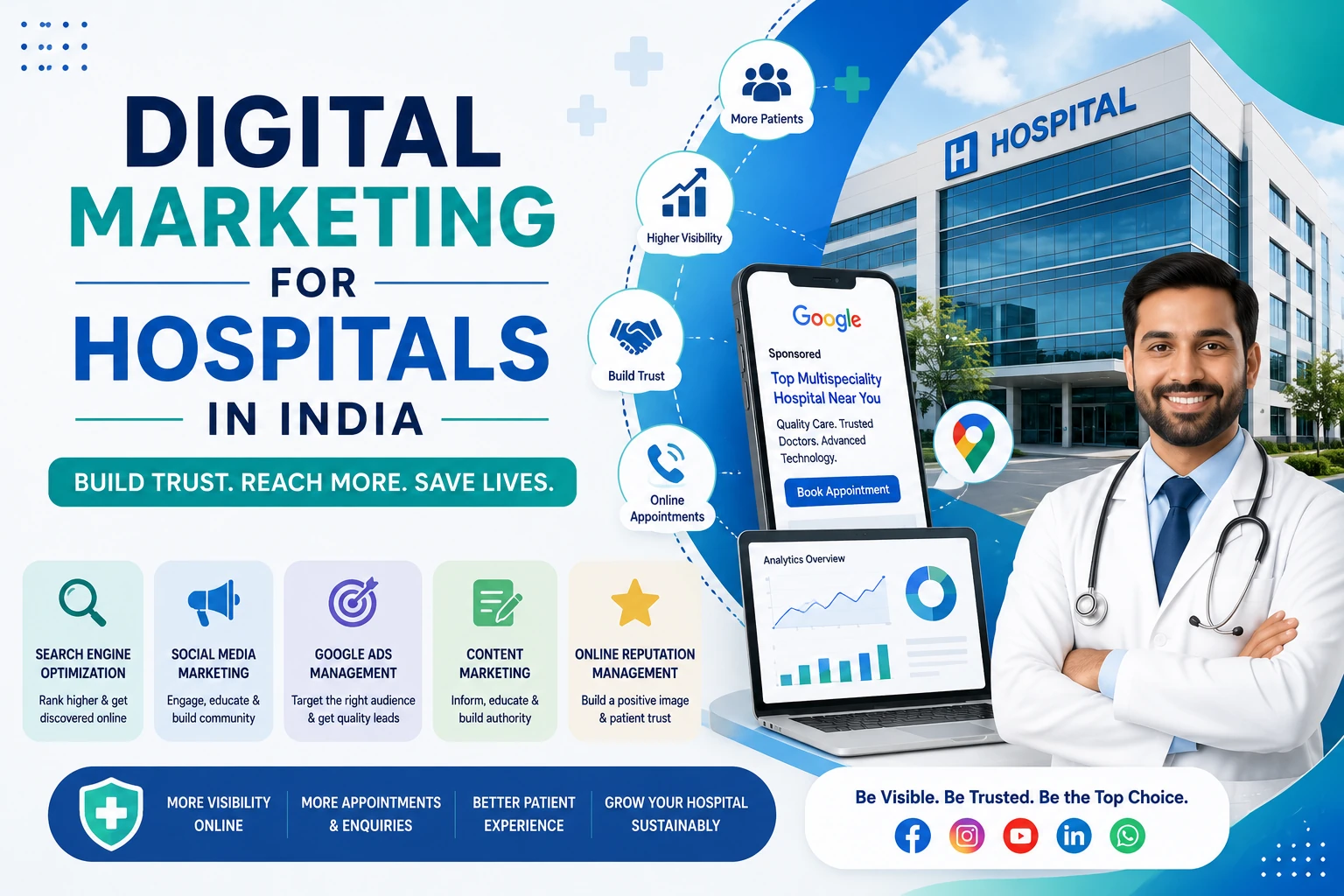
Indian hospitals face a paradox in 2026:
world-class medical infrastructure and highly qualified specialists —
yet patients in the same city choosing competitors
because they could not find the hospital online,
did not trust its digital presence, or found a competitor easier to contact.
Digital marketing for Indian hospitals is no longer about brand awareness alone —
it is the primary driver of patient admissions, OPD visits, and specialist consultations.
From multi-specialty hospitals in metros to single-specialty centres in tier-2 cities —
every Indian hospital that invests in strategic digital marketing
consistently outperforms equally capable competitors still relying on traditional referral networks.
This complete guide covers every digital marketing strategy
that increases patient volume for Indian hospitals in 2026.
Why Digital Marketing Is Critical for Indian Hospitals in 2026
- Patient journey starts online: 80% of Indian patients research hospitals online before choosing — reading reviews, checking specialist credentials, comparing facilities
- Referral network is declining: Younger patients and urban Indians no longer rely exclusively on GP referrals — they research independently
- Medical tourism competition: Indian patients researching hospitals abroad are captured by international competitors with superior digital presence
- Corporate health tie-ups: HR managers and corporate insurers research hospitals online before empanelment — digital presence determines corporate business
- NRI patient acquisition: Indians abroad seeking treatment for family members in India research hospitals entirely online
- Specialist discovery: Patients searching for specific specialties and procedures find hospitals through Google — not referrals
Strategy 1 — Hospital Website That Drives Admissions
Essential Hospital Website Pages
- Specialties and departments: Individual page per specialty — Cardiology, Orthopaedics, Oncology, Neurology — each targeting specific patient searches
- Doctor profiles: Every specialist with photo, qualifications, experience, research, and patient review aggregate
- Procedures and treatments: Individual pages for high-volume procedures — knee replacement, angioplasty, IVF, bariatric surgery
- International patient section: Cost comparisons, VISA support, accommodation, telemedicine consultations for NRI patients
- Patient stories: Video testimonials from real patients — condition, treatment, outcome
- Technology and infrastructure: Equipment, accreditations (NABH, JCI), technology — builds clinical credibility
- Insurance and TPA: Empanelled insurance companies — essential for corporate and insured patients
- Online appointment booking: Department-wise booking for OPD consultations
Hospital Website SEO Structure
- Homepage targets: “[Hospital Name] [City]” and “[Specialty] hospital [City]”
- Specialty pages: “Best cardiology hospital in [City]”, “Cancer treatment in [City]”
- Procedure pages: “Knee replacement surgery cost [City]”, “IVF treatment [City]”
- Doctor pages: “Dr. [Name] — [Specialty] — [Hospital] — [City]”
- Blog: weekly health education content targeting patient search queries
Strategy 2 — Local and National SEO for Hospitals
Local SEO for Hospital Google Business Profile
- Category: “Hospital” primary — add all specialties as secondary categories
- Services: every department, procedure, and specialty listed
- Photos: 50+ photos — hospital exterior, OPD, wards, ICU, operation theatre, equipment, specialists
- Reviews: target 200+ Google reviews — high review count builds trust for significant medical decisions
- Posts: weekly — specialist introductions, new technology, health awareness, patient milestones
- Q&A: “Does the hospital have a 24-hour emergency?”, “Which insurance companies are empanelled?”, “What is the consultation fee?”
National and Medical Tourism SEO
- “Best [specialty] hospital in India” — targets patients across India researching treatment centers
- “[Procedure] cost in India” — medical tourism searches from UAE, UK, USA, Africa
- “NABH accredited hospital [City]” — quality-seeking patients
- “[Specialty] hospital near [City]” — regional patient catchment
- Multilingual content: Hindi pages for non-English patients from smaller cities
Strategy 3 — Google Ads for Hospital Patient Acquisition
Hospital Google Ads Campaign Structure
- Campaign 1 — Emergency and Trauma: “Best emergency hospital [City]”, “24 hour hospital near me” — highest urgency, highest conversion
- Campaign 2 — High-Value Procedures: “Knee replacement [City]”, “Heart bypass surgery [City]”, “IVF cost [City]” — high procedure value justifies significant ad spend
- Campaign 3 — OPD Consultations: “[Specialty] doctor [City]”, “Best [specialist] [City]” — volume-driving campaign
- Campaign 4 — Medical Tourism: Targeted at UAE, UK, USA — “[Procedure] cost India”, “Best hospital India for [condition]”
- Campaign 5 — Branded: Hospital name + specialties — prevents competitor ads from appearing on branded searches
Hospital Google Ads Budget Guidance
- Small hospitals (50 to 100 beds): ₹50,000 to ₹1,00,000/month
- Mid-size hospitals (100 to 300 beds): ₹1,00,000 to ₹3,00,000/month
- Large multi-specialty (300+ beds): ₹3,00,000 to ₹10,00,000/month
- High-value procedures justify disproportionate spend — a single cardiac surgery or IVF cycle generates ₹2,00,000 to ₹10,00,000+ revenue
Strategy 4 — Social Media for Hospitals
Hospital YouTube — Highest Authority Builder
- Specialist doctor explanation videos — “Dr. [Name] explains [condition/procedure]”
- Patient testimonial series — condition, treatment at hospital, recovery outcome
- Technology showcase — new equipment, surgical techniques, diagnostic capabilities
- Health awareness videos — seasonal health topics tied to hospital specialties
- Live surgeries and procedures (where ethical and consented) — builds surgical credibility
- YouTube health content from Indian hospitals generates enormous organic search traffic
Hospital Facebook and Instagram
- Department spotlight posts — introducing specialists and their expertise
- Patient milestone celebrations — 1000th surgery, 500th baby delivered — community building
- Health awareness campaigns — World Heart Day, Cancer Awareness Month — tied to hospital specialties
- Infrastructure and technology posts — new equipment, accreditation achievements
- Staff appreciation content — humanizes the institution, builds trust
LinkedIn for Hospital Corporate and B2B
- Corporate health programme promotion — targeting HR managers for employee health tie-ups
- Medical research and case study publications — builds peer and academic authority
- Specialist doctor thought leadership — articles by senior consultants
- Insurance and TPA empanelment announcements
- Hospital achievements, rankings, accreditations — NABH, JCI, NABL
Strategy 5 — Online Reputation Management for Hospitals
Hospital reputation management requires a dedicated, proactive strategy —
a single viral negative review or news story can significantly impact patient volume.
Proactive reputation management protects and builds hospital brand authority.
- Google reviews: Systematic collection from satisfied patients — 200+ reviews at 4+ stars for strong local authority
- Review response protocol: Every review responded to within 24 hours — dedicated team for review management
- Negative review escalation: Sensitive cases escalated to patient relations team — offline resolution before online response
- Practo and Justdial: Complete profiles with updated specialist information and photos
- Media relations: Regular press releases for hospital milestones — new specialists, technology, achievements
- Wikipedia presence: Established hospitals benefit significantly from accurate Wikipedia pages
- Crisis management protocol: Pre-defined response procedure for negative media or social media incidents
Strategy 6 — WhatsApp and Digital Communication for Hospitals
- WhatsApp appointment booking: Dedicated department-wise WhatsApp numbers or a central booking WhatsApp
- Report delivery: Lab reports and discharge summaries via WhatsApp — reduces patient return visits, builds convenience reputation
- Admission status updates: Real-time surgery status updates to patient families — reduces anxiety and builds trust
- Discharge follow-up: Post-discharge WhatsApp calls at day 3, day 7, day 30 — reduces readmission and improves patient satisfaction scores
- Preventive health broadcasts: Seasonal health tips to opted-in patient database — keeps hospital top of mind
- Corporate employee health: WhatsApp channels for empanelled corporate employees
Strategy 7 — Medical Tourism Digital Marketing
India’s medical tourism market is worth billions annually —
with patients from the Middle East, Africa, Southeast Asia, and the Indian diaspora
traveling to India for high-quality, affordable healthcare.
Hospitals that invest in medical tourism digital marketing access this high-value patient segment.
- Dedicated international patient section on website — multilingual where appropriate
- Cost comparison pages: “[Procedure] cost in India vs UK/USA/UAE”
- Process guide: VISA, accommodation, airport transfer, interpreter services
- WhatsApp international inquiry line — 24/7 response for different time zones
- Google Ads targeting Indian diaspora populations in UAE, UK, USA, Canada
- YouTube videos in Arabic, French, Swahili — targeting medical tourism source countries
- Tie-ups with medical tourism agencies and facilitators
Measuring Hospital Digital Marketing Performance
- OPD volume from digital: Track new patient source — Google, social media, referral — monthly
- Admission attribution: Ask every admitted patient how they found the hospital
- Google Search Console: Organic traffic and keyword rankings monthly
- GBP Insights: Calls, direction requests, website clicks from Google Business Profile
- Google Ads ROAS: Revenue generated per rupee of ad spend — per campaign and specialty
- Review velocity: New reviews per week — declining velocity signals patient satisfaction issues
Conclusion
Digital marketing for Indian hospitals in 2026 is a strategic imperative —
not an optional marketing exercise.
Patients, corporate health programmes, insurance companies, and medical tourists
all begin their hospital selection process online.
Hospitals with comprehensive digital presence — strong SEO, managed Google reviews,
specialist content on YouTube, and seamless WhatsApp communication —
consistently win patient volume from equally capable competitors
with weaker digital infrastructure.
Invest in digital marketing as seriously as you invest in medical infrastructure —
the ROI at hospital scale is transformational.
Call To Action
Want a complete digital marketing strategy for your hospital?
Get a free hospital marketing consultation today — we build and manage comprehensive digital marketing systems for Indian hospitals that consistently increase patient admissions.
Or contact us on WhatsApp to discuss your hospital’s digital marketing requirements.
Frequently Asked Questions
What is digital marketing for hospitals in India?
Digital marketing for hospitals includes all online strategies that attract patients — website SEO, Google Business Profile management, Google Ads, social media content, YouTube videos, online reputation management, and WhatsApp communication systems. It covers both local patient acquisition and national or international medical tourism marketing depending on hospital scale and specialty focus.
How much should an Indian hospital spend on digital marketing?
Small hospitals (50 to 100 beds) should invest ₹50,000 to ₹1,50,000/month on digital marketing. Mid-size hospitals invest ₹1,50,000 to ₹5,00,000/month. Large multi-specialty hospitals invest ₹5,00,000 to ₹15,00,000/month. Given that a single surgery generates ₹2,00,000 to ₹20,00,000 in revenue, even modest digital marketing investment achieves exceptional ROI when attribution is tracked carefully.
Which digital marketing channel works best for hospitals in India?
Google Search Ads targeting high-value procedure keywords delivers the fastest, most measurable patient acquisition ROI for Indian hospitals. Google Business Profile optimization drives OPD volume from local searches. YouTube specialist content builds long-term authority and medical tourism patient acquisition. All three channels work best in combination — immediate results from Ads, local volume from GBP, long-term authority from YouTube and SEO.
How do hospitals get more Google reviews in India?
Implement a systematic review collection process: train discharge nursing staff to request Google reviews from satisfied patients, display review QR codes in discharge lounges and OPD waiting areas, send WhatsApp review request links to patients 3 to 5 days post-discharge, and include review request links in discharge summary documents. Target 5 to 10 new reviews per week — consistency builds the review volume that dominates local search.
How can hospitals attract medical tourism patients digitally in India?
Create a dedicated international patient section on the hospital website with procedure cost comparisons (India vs USA, UK, UAE), step-by-step process guides for international patients, multilingual content for target markets, and 24/7 WhatsApp inquiry support. Run Google Ads targeting Indian diaspora populations in UAE, UK, USA, and Canada. Publish YouTube videos in English and Arabic explaining procedures and hospital facilities.
What social media platforms should Indian hospitals use?
YouTube is the most valuable platform for Indian hospitals — specialist explanation videos rank on Google Search and build deep trust for significant medical decisions. Facebook reaches the 35+ demographic making most hospital admission decisions. LinkedIn targets corporate health managers and referring physicians. Instagram works best for hospitals with strong visual content — maternity, cosmetic, and paediatric specialties perform particularly well.
How long does digital marketing take to increase hospital patient volume?
Google Ads increases patient inquiries within 48 to 72 hours of campaign launch. GBP optimization improves local search visibility within 4 to 8 weeks. SEO produces organic traffic growth within 4 to 6 months. YouTube channel authority builds over 6 to 12 months of consistent publishing. Most Indian hospitals see 20 to 50% increase in digital patient inquiries within 6 months of implementing a comprehensive digital marketing strategy.
Is NABH accreditation important for hospital digital marketing in India?
Yes — NABH and JCI accreditation are powerful digital trust signals for Indian hospitals. Display accreditation badges prominently on the website, GBP profile, and all marketing materials. Create a dedicated accreditation page explaining what NABH means for patient safety and care quality. For medical tourism, JCI accreditation is particularly significant — many international patients specifically search for JCI-accredited Indian hospitals.