Home
Home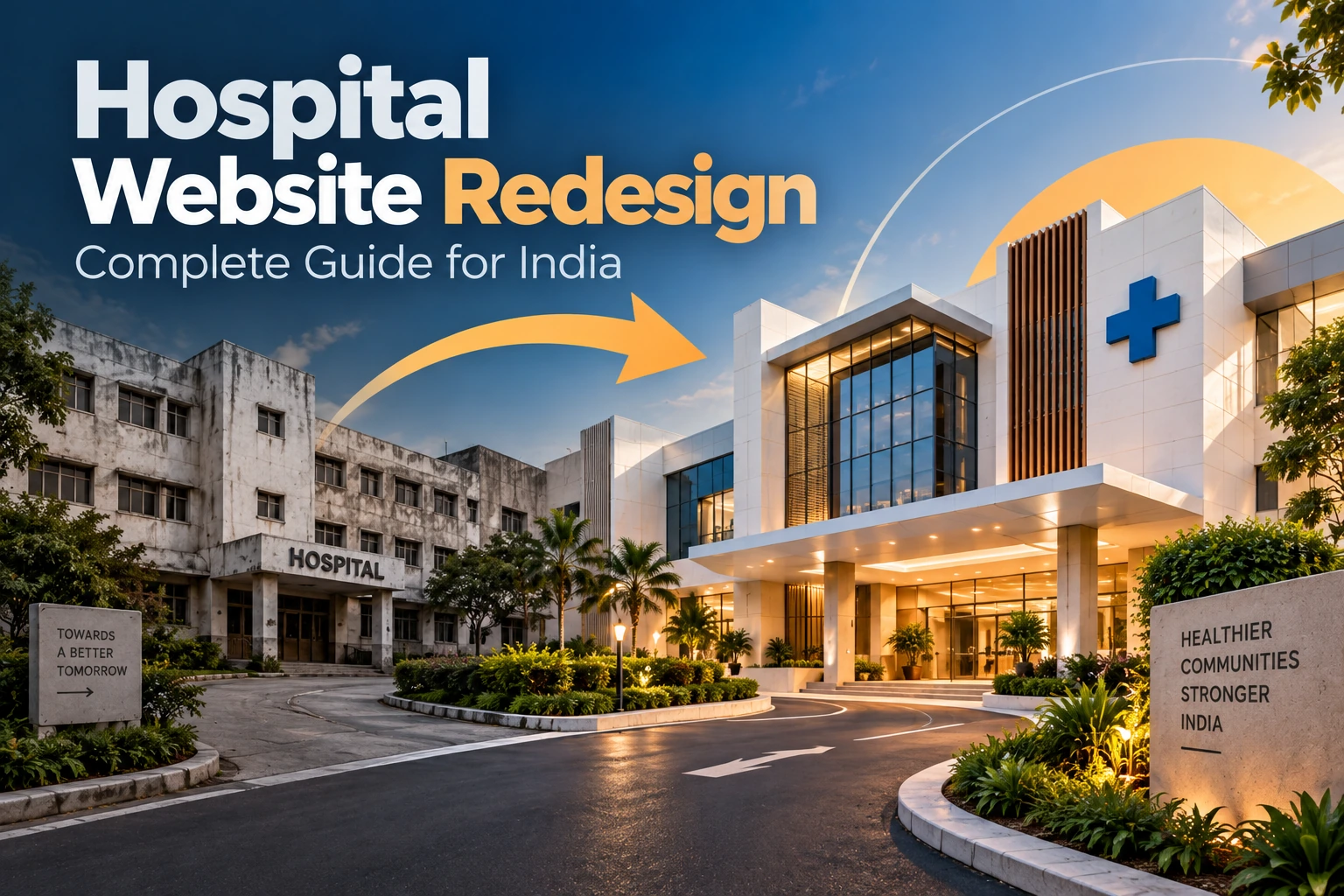
Most Indian hospital websites are overdue for a redesign.
A website built 4 to 7 years ago —
without individual specialty pages, mobile-optimized booking,
WhatsApp integration, or schema markup —
is actively losing patients to competitors whose websites were built for 2026 patients.
But a poorly executed hospital website redesign can simultaneously
destroy years of SEO rankings, break existing patient booking flows,
and disorient the staff who manage daily content updates.
This complete guide covers everything Indian hospitals need to know
about redesigning their website correctly —
when to redesign, what to prioritize, how to protect existing SEO rankings,
and how to build a new hospital website
that consistently generates patient enquiries across all specialties.
Signs Your Hospital Website Needs a Redesign
- Mobile experience is poor: Text too small, buttons too close together, slow loading on 4G — 80%+ of hospital website visitors are on mobile
- No individual specialty pages: A generic “we treat all conditions” services page instead of dedicated Cardiology, Orthopaedics, Maternity pages — cannot rank for specialty searches
- No doctor profile pages: Doctors listed as a simple text list — referred patients cannot find specialist information
- No online booking: Only a contact form or phone number — patients researching at night cannot book
- No WhatsApp integration: Missing India’s most preferred patient communication channel
- Slow loading: Mobile PageSpeed below 60 — Google penalizes slow websites in rankings
- Outdated design: Visual design more than 5 years old — signals institutional stagnation to image-conscious patients
- Declining organic traffic: Google Search Console showing consistent traffic decline — outdated website losing rankings
- Low enquiry conversion rate: Significant website traffic but few WhatsApp or call enquiries — conversion failure
- NABH or accreditation not displayed: Missing highest-trust signals Indian hospital patients look for
Hospital Website Redesign vs Refresh — Which Do You Need?
Redesign (Full Rebuild) — Required When:
- Website is on an outdated platform — Flash, old Joomla, or bespoke CMS with no modern plugin support
- Website has no individual specialty or doctor pages — structural content architecture problem
- Mobile experience is fundamentally broken — not responsive or extremely slow
- Website has no SEO foundation — no URL structure, no schema, no meta tags
- Visual design is more than 6 to 7 years old — dated enough to actively reduce trust
Refresh (Significant Update) — Sufficient When:
- Website is on WordPress and structurally sound — needs visual update and feature additions
- Specialty pages exist but lack depth — need content expansion and better conversion elements
- Doctor profiles exist but are outdated — need updated photos, credentials, booking links
- Mobile experience is acceptable but not optimized — needs WhatsApp button, speed improvements
- Design is 3 to 5 years old — needs modernizing without full rebuild
Pre-Redesign Audit — What to Preserve
Before a single line of new code is written —
audit everything on the existing hospital website
that has SEO value and must be preserved through the redesign.
SEO Assets to Protect
- Existing page URLs: Export every URL from Google Search Console — any URL receiving organic traffic must either be preserved exactly or 301 redirected
- Indexed pages: Every page Google has indexed — check via Search Console coverage report
- Ranking keywords: Export all keywords currently driving clicks in Search Console — measure retention after launch
- Backlinks: Export from Ahrefs or Google Search Console links report — high-authority backlinks point to specific URLs that must be preserved or redirected
- Meta titles and descriptions: Pages with custom-written, ranking meta tags — preserve or improve these, never replace with generic content
- Schema markup: Any existing schema implementation — must be preserved and expanded in new site
Content to Audit and Preserve
- All specialist doctor profiles — names, qualifications, OPD timing
- Specialty and department content — can be improved but core information preserved
- Patient testimonials — cannot be re-collected once lost
- Blog and health article archive — years of SEO-valuable content
- Insurance and TPA lists — operational information patients rely on
- Accreditation details — NABH, JCI certificates and details
Hospital Website Redesign — Priority Features to Build
1. Individual Specialty Department Pages
- One comprehensive page per specialty: Cardiology, Orthopaedics, Gynaecology, Neurology, Oncology, Gastroenterology, Urology, Paediatrics, ENT, Ophthalmology, Emergency
- Each page: 1,200+ words — conditions treated, procedures, technology, specialists, FAQ, cost, WhatsApp CTA
- Indian patient context: conditions prevalent in India, Indian dietary and lifestyle factors, insurance coverage guidance
- SEO target: “[Specialty] Hospital in [City]” — each page targets a high-value local specialty search
2. Individual Doctor Profile Pages
- Every specialist: qualifications, subspecialty, experience, procedures, publications, OPD timing
- Professional photos: in clinical setting — not passport photos
- Physician schema markup on every doctor page
- Direct booking CTA: “Book OPD with Dr. [Name]” — WhatsApp or online booking
- Link to department page: each doctor page links to their specialty department
3. Online Appointment Booking
- Real-time OPD slot booking: specialty → doctor → available slot — 3-step maximum on mobile
- Amelia or Bookly Pro: best WordPress hospital booking plugins
- Automated confirmation: WhatsApp or SMS immediately after booking
- Reminder system: 24-hour appointment reminder — reduces no-shows 30 to 40%
- WhatsApp booking alternative: for patients who prefer direct conversation
4. Mobile-First Design
- Emergency number: click-to-call in mobile header — always visible
- WhatsApp button: fixed at mobile screen bottom — never scrolls out of view
- Page speed: 80+ mobile PageSpeed — all images WebP, lazy loading, caching
- Font: 16px minimum body text — readable without zooming
- Booking: 3-step maximum on mobile — removed friction increases conversion
5. Trust Signal Architecture
- NABH badge: homepage hero and all department pages
- Google rating widget: live reviews on homepage
- Years established and patient volume: near hospital name in hero
- Insurance logos: footer and dedicated insurance page
- Government empanelment: CGHS, ECHS, Ayushman Bharat — official recognition
- Specialist credentials: MD/MS/DM on every doctor photo
Protecting SEO Rankings During Hospital Website Redesign
Hospital website redesigns that ignore SEO can lose 40 to 80% of organic traffic overnight —
destroying years of ranking work in a single launch.
These steps prevent SEO ranking loss during redesign.
Pre-Launch SEO Checklist
- 301 redirect map: Every old URL with traffic or backlinks mapped to new URL equivalent — no broken links
- URL preservation: Where possible, keep existing URLs identical — /cardiology/ stays /cardiology/ — no redirects needed
- Meta tags: All existing meta titles and descriptions carried over — improve where possible, never replace with generic
- Schema markup: Hospital, Physician, FAQ schema implemented on new site before launch
- XML sitemap: New sitemap submitted to Google Search Console immediately after launch
- Crawl test: Screaming Frog crawl of new site before launch — identify broken links and missing redirects
- Search Console: Monitor indexing and ranking in first 4 weeks after launch — catch and fix ranking drops quickly
Post-Launch SEO Monitoring
- Week 1 to 2: daily Search Console check — indexing, crawl errors, ranking changes
- Week 3 to 4: compare organic traffic to pre-launch baseline — identify any significant drops
- Month 2: ranking report vs pre-launch — any specialty page ranking losses need immediate investigation
- Any traffic drop: check redirect implementation, missing meta tags, crawl errors — fix within 48 hours
Hospital Website Redesign Cost in India
- Refresh (existing WordPress, visual update + feature additions): ₹40,000 to ₹1,00,000
- Standard redesign (full rebuild, 30 to 50 pages, specialty pages + doctor profiles): ₹80,000 to ₹2,00,000
- Professional redesign (60 to 100 pages, online booking, custom design): ₹2,00,000 to ₹5,00,000
- Enterprise redesign (100+ pages, patient portal, HIS integration): ₹5,00,000 to ₹20,00,000+
- Timeline: Standard redesign 10 to 16 weeks — content collection is typically the longest phase
Hospital Website Redesign Project Timeline
- Week 1 to 2: Discovery and audit — existing website SEO audit, content inventory, URL mapping, competitor analysis
- Week 2 to 4: Information architecture — sitemap, wireframes, specialty page structure, doctor profile template
- Week 4 to 8: Design and development — homepage, department page templates, doctor profiles, booking system
- Week 6 to 10: Content production — specialty page copywriting, doctor profile content, photo collection
- Week 10 to 12: SEO implementation — meta tags, schema, redirects, sitemap, Search Console setup
- Week 12 to 14: Testing — mobile, booking system, all forms, page speed, cross-browser
- Week 14 to 16: Launch and monitoring — sitemap submission, redirect verification, Search Console monitoring
For the complete feature list your redesigned hospital website must include,
see our guide on hospital website features Indian patients expect.
For the best practices governing every design decision in your redesign,
see our complete guide on hospital website design best practices in India.
Conclusion
A hospital website redesign done correctly
transforms a passive digital brochure into an active patient acquisition system —
generating specialist enquiries, OPD bookings, and surgical consultations
from Google search, Google Maps, and WhatsApp 24 hours a day.
Done incorrectly, it destroys existing SEO rankings
and takes 6 to 12 months to recover from.
Plan the redesign with SEO preservation as the first priority.
Build individual specialty pages and doctor profiles as the core content structure.
Implement mobile-first design, WhatsApp booking, and trust signal architecture.
Monitor rankings closely for the first 4 weeks post-launch.
A correctly executed hospital website redesign
delivers 3 to 5x more patient enquiries than the website it replaces
within 6 months of launch.
Call To Action
Want your hospital website redesigned to generate consistent patient enquiries?
Get a free hospital website redesign consultation today — we audit your existing hospital website, plan the redesign with full SEO protection, and build a new patient-converting website that fills OPD and specialist appointment books.
Or contact us on WhatsApp to discuss your hospital website redesign requirements.
Frequently Asked Questions
When should a hospital redesign its website in India?
Redesign when: the website has no individual specialty department pages, no mobile optimization, no WhatsApp integration, no online booking, declining organic traffic in Search Console, or a design more than 5 to 6 years old. A hospital website that generates fewer than 20 patient enquiries per month from organic search despite significant traffic is a clear signal that redesign — not just content addition — is needed. An outdated hospital website actively loses patients to competitors with modern, conversion-optimized alternatives.
How do you protect SEO rankings during a hospital website redesign?
Before launch: export all URLs with organic traffic from Google Search Console, create a 301 redirect map for every changed URL, preserve all existing meta titles and descriptions, implement schema markup on new site, and crawl the staging site with Screaming Frog to identify broken links. After launch: submit new XML sitemap immediately, monitor Search Console daily for 4 weeks, compare organic traffic to pre-launch baseline weekly. Any ranking drops should be investigated within 48 hours — usually a missed redirect or missing meta tag.
How long does a hospital website redesign take in India?
A standard hospital website redesign (30 to 50 pages with specialty pages and doctor profiles) takes 10 to 16 weeks. A professional redesign with custom design, online booking, and 60 to 100 pages takes 16 to 24 weeks. The longest phase is typically content production — collecting updated doctor credentials, writing specialty page content, gathering photography. Having all doctor information, specialty page content briefs, and photography ready before development begins can reduce the timeline by 4 to 6 weeks.
Should a hospital redesign its website or just refresh it?
Refresh (significant update to existing WordPress site) is sufficient when the structural content architecture is sound — specialty pages exist, doctor profiles exist, but need updating and modernizing. Full redesign (complete rebuild) is required when the website has no individual specialty pages, no doctor profile system, is on an outdated platform, or has fundamentally broken mobile experience. Most Indian hospital websites older than 5 years on non-WordPress platforms need full redesigns; WordPress hospitals often need refreshes.
What is the most important thing to add in a hospital website redesign?
Individual specialty department pages are the highest-impact addition in any hospital website redesign — each one targeting a specific high-value specialty search (“Cardiology Hospital in [City]”) that drives new patient enquiries. The second most important addition is individual doctor profile pages — capturing referred patient name searches that convert at very high rates. Together, specialty pages and doctor profiles transform a generic hospital website into a multi-specialty patient acquisition system that ranks for dozens of specific searches simultaneously.
How much does a hospital website redesign cost in India?
Hospital website refresh (visual update to existing WordPress, ₹40,000 to ₹1,00,000), standard redesign (full rebuild, 30 to 50 pages, ₹80,000 to ₹2,00,000), professional redesign (60 to 100 pages with online booking and custom design, ₹2,00,000 to ₹5,00,000), and enterprise redesign (patient portal, HIS integration, ₹5,00,000 to ₹20,00,000+). A single high-value surgical patient acquired through the redesigned website typically covers the entire investment within the first month of launch.
Should hospitals migrate to a new platform during a redesign?
WordPress is the recommended platform for Indian hospital websites undergoing redesign — the largest development ecosystem, best SEO plugin support (Rank Math), excellent booking plugins (Amelia, Bookly Pro), and easiest content management for hospital marketing teams. Migrating from a bespoke CMS or old Joomla to WordPress during redesign is strongly recommended — even though it adds complexity, the long-term benefit of a maintainable, SEO-capable platform outweighs the one-time migration cost significantly.
How do you measure the success of a hospital website redesign?
Measure redesign success through: monthly WhatsApp and online booking enquiries vs pre-redesign baseline, organic traffic from Google Search Console (should maintain or grow from launch month), specialty keyword rankings vs pre-redesign, mobile PageSpeed score improvement, Google review growth (improved patient experience drives more reviews), and patient source surveys (“how did you find us?”). A successful hospital website redesign typically delivers 2 to 4x more monthly online patient enquiries within 6 months compared to the website it replaced.