Home
Home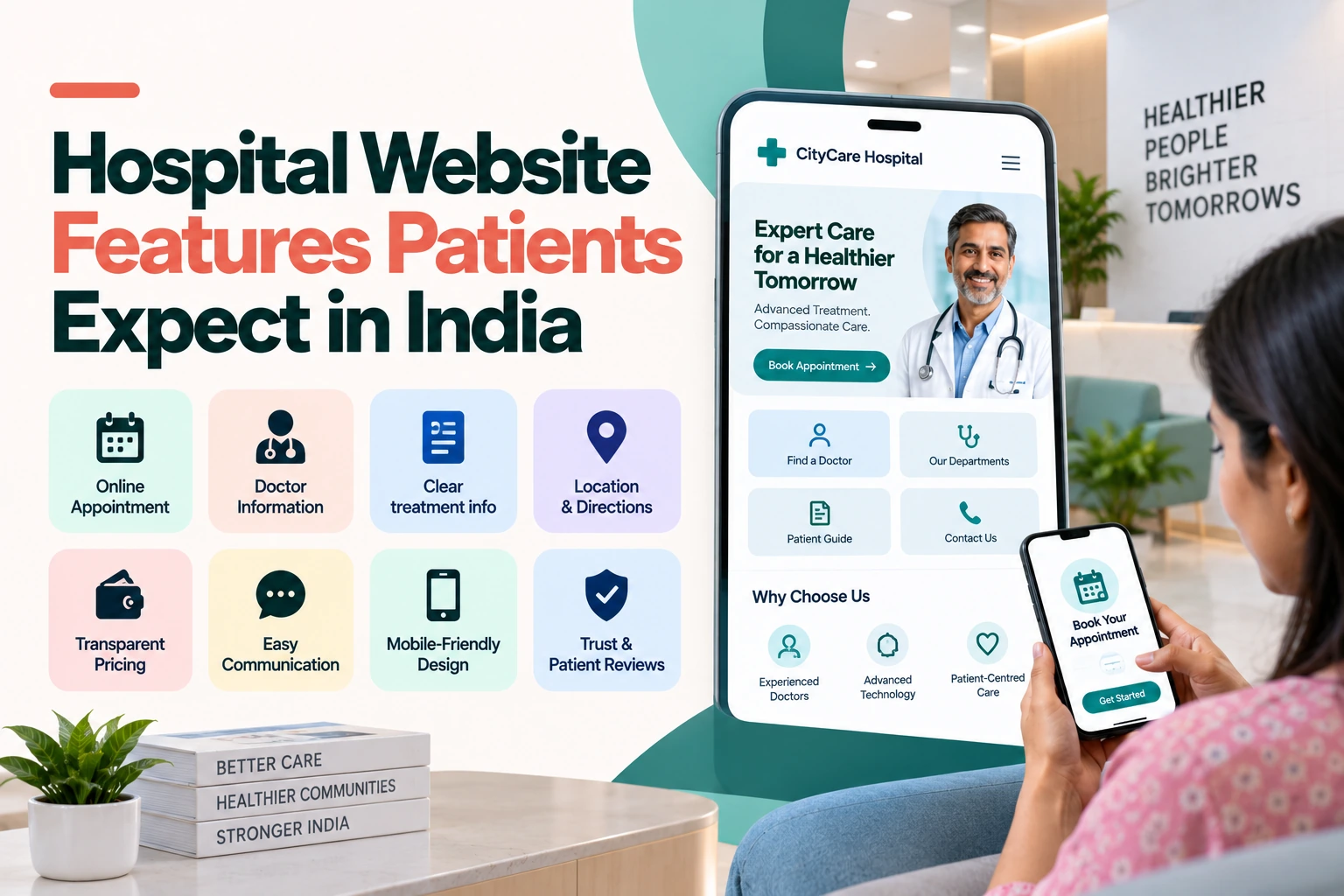
Indian patients researching a hospital for surgery, delivery, or specialist consultation
arrive at your website with specific expectations —
and they make their decision within seconds of landing.
A hospital website that fails to provide specialist profiles, online appointment booking,
insurance information, and clear trust signals
sends patients back to Google to find a competitor that does.
In 2026, Indian hospital patients are more digitally sophisticated than ever.
They compare hospitals across multiple websites before choosing.
They expect the same information quality from a hospital website
that they get from a bank or e-commerce platform.
This guide covers every feature Indian patients now expect —
and that your hospital website must have to win their trust and their appointment.
Feature 1 — Online Appointment Booking
Online appointment booking is the most expected — and most commonly missing —
feature on Indian hospital websites.
Patients researching at 10 PM cannot call the hospital —
a website without online booking loses them to competitors who offer it.
- Department and doctor selection: Patient selects specialty, then specific doctor, then available slot
- Real-time slot availability: Patients see actual available OPD slots — not a request form with uncertain response
- WhatsApp booking alternative: For patients who prefer direct contact — WhatsApp booking button alongside online booking
- Confirmation: Automated WhatsApp or SMS confirmation with appointment details immediately
- Reminder: Automated reminder 24 hours before appointment — reduces no-shows by 30 to 40%
- Booking plugins: Amelia, Bookly Pro, or custom hospital management system integration
- Mobile-optimized booking: 3-step maximum on mobile — specialty → doctor → slot — minimal friction
Feature 2 — Specialist Doctor Profiles
Indian patients choosing a hospital for surgery or specialist consultation
research the doctor as much as the institution.
A hospital website without detailed specialist profiles
loses patients who want to know who will be treating them
before committing to a significant medical decision.
- Professional photo: In clinical setting, approachable — patients choose people they can see and trust
- Full qualifications: MBBS, MS, MCh, DM, MD — with awarding institution and year
- Medical Council registration: Registration number — legally required trust signal
- Subspecialty: Interventional cardiology, joint replacement, minimal access surgery — specific expertise
- Experience metrics: Years of practice, procedures performed, success rates where available
- Affiliations: Professional associations — Cardiological Society of India, Indian Orthopaedic Association
- Publications and presentations: Peer-reviewed publications, conference presentations — academic credibility
- Available days and OPD timing: Patients plan visits around specialist availability
- Direct appointment CTA: “Book Appointment with Dr. [Name]” on every doctor profile
- Patient reviews for that doctor: If available — specific doctor reviews build personal trust
Feature 3 — Insurance and Cashless Facility Information
Insurance information is one of the most searched topics on hospital websites in India —
and one of the most commonly outdated or missing.
A patient whose insurance company is not listed on your website
will assume you are not empanelled and choose a different hospital.
- Complete insurance list: Every insurance company and TPA accepted — Star Health, HDFC Ergo, New India Assurance, United India, CGHS, ECHS, ESI, Ayushman Bharat, state schemes
- Cashless process: Step-by-step guide to using cashless facility — pre-authorization, documents required, process timeline
- TPA contact details: Direct TPA contacts for pre-authorization — removes friction from patient insurance process
- Government schemes: CGHS, ECHS, Ayushman Bharat eligibility and process — significant patient segment in India
- Update frequency: Insurance empanelment list must be reviewed and updated quarterly — outdated lists create frustrated patients and negative reviews
- Insurance helpdesk: Dedicated phone number or WhatsApp for insurance queries — patients have specific and urgent questions
Feature 4 — Department and Specialty Pages
Patients arrive at hospital websites searching for specific conditions or specialties —
not generic “we are a multi-specialty hospital” content.
A dedicated, comprehensive department page converts specialty-seeking patients;
a generic services list does not.
- Dedicated page per department: Cardiology, Orthopaedics, Gynaecology, Neurology, Oncology, Gastroenterology, Urology, Paediatrics, ENT, Ophthalmology, Emergency
- Conditions treated: List of conditions managed in that department — patients self-identify their need
- Procedures performed: With brief description of each — knee replacement, angioplasty, laparoscopic cholecystectomy
- Specialist doctors: Department doctors listed with links to individual profiles
- Technology: Equipment specific to that department — cath lab for cardiology, arthroscopy for orthopaedics
- Patient success stories: Department-specific patient testimonials — highly converting trust element
- FAQ section: 8 to 10 patient questions specific to that specialty
- Appointment CTA: “Book [Specialty] Appointment” at top and bottom of every department page
Feature 5 — Accreditation and Trust Signals
Indian patients making high-stakes medical decisions —
surgery, cancer treatment, delivery — research institutional credibility extensively.
Trust signals must be prominent and verifiable.
- NABH accreditation: Badge prominently displayed on homepage — most recognized hospital quality marker in India
- JCI certification: If applicable — international standard, recognized by patients seeking highest quality
- Years established: “Serving [city] since [year]” — longevity signals institutional stability
- Bed count and ICU capacity: Signals institutional size and capability for complex care
- Annual patient volume: “50,000+ patients treated annually” — volume implies experience
- Key procedure counts: “5,000+ successful cardiac procedures” — specific outcome statistics
- Google rating: Embed live Google rating widget — most trusted review source for Indian patients
- Media coverage: News features and press mentions — third-party validation
- Government empanelments: CGHS, ECHS, state government schemes — official recognition
Feature 6 — Patient Testimonials and Success Stories
- Video testimonials: 8 to 12 patient videos — cardiac patients, maternity patients, surgical patients
- Written case studies: Detailed recovery stories — “How [Hospital] helped me walk again after a severe accident”
- Before/after outcomes: Where clinically appropriate — orthopaedic mobility, cardiac function improvement
- Department-specific testimonials: Each department page shows relevant patient stories
- Google review widget: Live Google reviews embedded — fresh, third-party validated patient feedback
- Patient video format: Patient speaking naturally — unscripted, authentic, 60 to 120 seconds
Feature 7 — Emergency and Ambulance Information
Emergency information must be immediately findable on any page —
patients in acute situations or their families have zero patience
for navigating complex menus to find an emergency contact number.
- Emergency number in header: Visible on every page — red highlight, large font
- Ambulance number: Separate from general reception — prominently displayed
- 24-hour emergency indicator: Clear statement that emergency services are available 24 hours
- Emergency department overview: Conditions treated, facilities available — trauma bay, cath lab, NICU
- Directions to emergency entrance: Separate from main entrance — with map
- What to bring in emergency: Documents, insurance card, previous records — reduces patient stress
Feature 8 — Patient Portal and Health Records
- Patient login: Access to previous discharge summaries, lab reports, imaging results
- Appointment history: Past and upcoming appointments visible
- Prescription download: Digital prescriptions accessible after OPD visit
- Lab report access: Reports available online within hours of completion — reduces return visits for routine results
- Bill payment: Online payment of outstanding hospital bills
- Feedback submission: Structured patient feedback — feeds review pipeline
- Patient portals increase patient satisfaction and review rates significantly — patients feel the hospital values their time
Feature 9 — Health Information and Blog
- Department-specific health articles authored by specialist doctors
- Condition guides: “Living with diabetes”, “Preparing for knee replacement”, “What to expect during chemotherapy”
- Seasonal health content: monsoon diseases, summer heat precautions — timely and local
- Video health content: specialist doctors explaining conditions and treatments
- Author attribution: every article by named specialist with qualifications — builds E-E-A-T for medical SEO
- Publish 4 posts per month — large institution content cadence
Feature 10 — Mobile-Optimized Design
- 80%+ of hospital website visitors are on mobile — mobile experience is paramount
- Emergency number: click-to-call from mobile — one tap to ambulance or emergency line
- WhatsApp button: fixed at bottom of mobile screen — always visible for appointment booking
- Fast loading: hospital websites have many pages and images — 80+ mobile PageSpeed score required
- Appointment booking: 3-step maximum on mobile — specialty → doctor → slot
- Doctor profiles: readable without zooming — large text, clean layout
- Insurance list: searchable on mobile — patients search by their specific insurance company
For guidance on building a hospital website that converts visitors into booked appointments,
see our guide on hospital website design best practices in India.
For the SEO strategy that drives patient traffic to your hospital website,
see our complete hospital SEO guide for Indian healthcare centres.
Conclusion
Indian hospital patients in 2026 arrive at your website
with the same expectations they have for any sophisticated digital platform —
clear information, easy booking, specialist credibility, and fast mobile experience.
A hospital website that provides online appointment booking,
detailed specialist profiles, comprehensive insurance information,
and prominent accreditation trust signals
converts significantly more visitors into booked patients
than websites that provide only general hospital information.
Audit your current website against this feature list —
and prioritize the highest-gap, highest-impact improvements first.
Call To Action
Want a hospital website built with all the features Indian patients expect?
Get a free hospital website audit today — we identify which features your hospital website is missing and build the patient-converting elements that fill OPD and specialist appointment books.
Or contact us on WhatsApp to discuss your hospital website requirements.
Frequently Asked Questions
What is the most important feature on an Indian hospital website?
Online appointment booking is the highest-priority missing feature on most Indian hospital websites. Patients researching hospitals in the evening cannot call — a website without booking loses them permanently. The second most critical feature is detailed specialist doctor profiles — Indian patients research the specific doctor before choosing a hospital for surgery or specialist consultation. Both features combined reduce patient acquisition friction and significantly increase website-to-appointment conversion rate.
Should Indian hospital websites show insurance information?
Yes — insurance information is one of the most searched topics on hospital websites and one of the most commonly outdated. Patients whose insurance company is not listed assume the hospital is not empanelled and choose a competitor. Maintain a complete, current list of all accepted insurance companies and TPAs. Update quarterly — insurance empanelments change and incorrect information creates patient frustration and negative reviews. Include a dedicated insurance helpdesk contact for patient queries.
How important is mobile optimization for hospital websites in India?
Critical — 80%+ of Indian hospital website visitors are on mobile. Emergency contacts must be one tap to call from mobile. WhatsApp appointment booking must be visible at all times on mobile. Online booking must be completable in 3 steps on a small screen. Hospital websites typically have large amounts of content and images — aggressive image compression and performance optimization are required to achieve the 80+ mobile PageSpeed score that prevents patient abandonment.
Do Indian hospitals need a patient portal on their website?
Yes — patient portals are increasingly expected by urban Indian patients. Access to digital lab reports, discharge summaries, prescriptions, and appointment history reduces return visits for routine information and significantly improves patient satisfaction scores. Patients who can access their health records digitally are more likely to leave positive Google reviews and return for future care. Patient portals also reduce reception workload — patients answer their own administrative queries online.
How many doctor profiles should a hospital website have?
Every consulting and visiting specialist should have a dedicated profile page — not just department heads. Referred patients search for the specific doctor by name (“Dr. [Name] cardiologist [city]”) — these searches convert at very high rates. Doctor profile pages also rank on Google for specialty searches, improving hospital SEO significantly. A hospital with 20 specialists should have 20 individual doctor pages — each with qualifications, subspecialty, experience, OPD timing, and direct appointment booking.
What trust signals are most important on Indian hospital websites?
The highest-impact trust signals for Indian hospital websites: NABH accreditation badge (most recognized hospital quality marker), years established (“serving [city] since [year]”), Google rating widget (live reviews), annual patient or procedure volume statistics, government empanelment logos (CGHS, Ayushman Bharat), and specialist doctor credentials on every department page. For surgical specialties — specific procedure volume statistics (“5,000+ successful knee replacements”) convert high-stakes patients most effectively.
Should hospital websites have video content?
Yes — video content significantly increases hospital website conversion rates. Patient testimonial videos (cardiac patients, surgical patients, maternity patients) are the highest-converting trust element for Indian hospital patients making significant medical decisions. Doctor introduction videos build personal trust before the first appointment. Department overview videos show facilities and equipment. Video content also improves SEO — Google’s algorithm rewards pages with video engagement signals. Aim for 8 to 12 patient testimonial videos covering key specialties.
How should hospital websites handle emergency information?
Emergency information must be immediately accessible on every page — not buried in navigation menus. Display emergency and ambulance phone numbers in the website header with click-to-call functionality on mobile. Include a dedicated emergency page covering conditions treated, facilities, entry point directions, and what documents to bring. For 24-hour emergency hospitals, display this prominently in the GBP description, homepage header, and Google Ads extensions — emergency patients choose the hospital they can find fastest.