Home
Home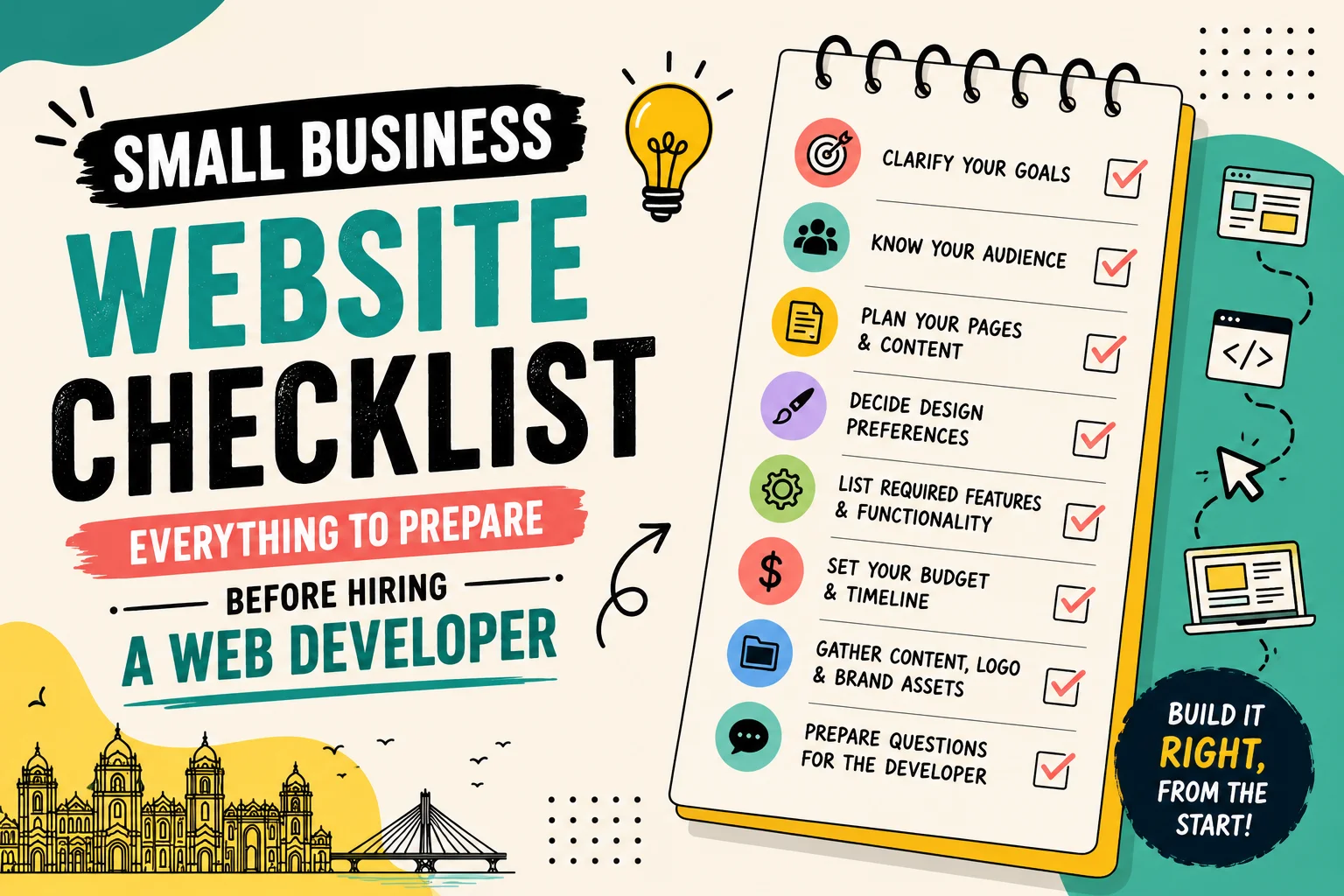
Most Indian small businesses waste weeks of development time — and thousands of rupees in extra charges —
because they hire a web developer without being properly prepared.
Developers charge for their time. Every back-and-forth email asking for missing content costs you money and delays your launch.
This complete checklist tells you exactly what to prepare, what to decide, and what to ask
before hiring any web developer in India in 2026 —
so your project runs smoothly, delivers on time, and stays within budget.
Section 1: Business Clarity Checklist
Before any developer can build your website, you need clarity on your own business goals.
Answer these questions before your first meeting:
- What is the primary goal of this website? (Generate leads / Sell products online / Build brand credibility / All three)
- Who is your target customer? (Age, city, industry, income level)
- What action do you want visitors to take? (Call you / Fill a form / WhatsApp / Make a purchase)
- What makes your business different from competitors? (Your USP)
- Which 3 competitor websites do you like the design of — and why?
- What is your budget range? (Be honest — this determines what is possible)
- When do you need the website live? (Realistic timeline expectations)
Section 2: Content Preparation Checklist
Content delays are the #1 reason websites launch late in India.
Have all of this ready before the project begins — not during development.
Text Content
- Business name, tagline, and brand description (2 to 3 paragraphs)
- About Us content — your story, experience, team, and why clients choose you
- Complete list of all services with description for each (3 to 5 sentences per service)
- Pricing information — even “starting from” prices if exact pricing varies
- Contact information — phone, WhatsApp, email, full address with PIN code
- 3 to 5 client testimonials — client name, business name, and what you did for them
- FAQ content — 5 to 8 common questions your customers ask
- Any specific content for each page you want on the website
Images and Media
- Logo file in PNG format with transparent background (ask your designer if you need this created)
- Brand color codes in HEX format (e.g., #1a1a2e) — if you have brand colors
- Professional photos of your team, office, or workspace
- High-quality photos of your products, completed projects, or work samples
- Any specific images you want used on the website
- If no photos are available — budget for stock photos or AI-generated images
Section 3: Technical Requirements Checklist
Decide these before meeting any developer — not after they have started building.
- Domain name — do you already have one? If not, what name do you want? (.in or .com?)
- Hosting — do you have existing hosting? If not, what is your monthly/annual budget?
- Pages needed — list every page: Home, About, Services (list each), Blog, Contact, etc.
- Do you need eCommerce? If yes — how many products? What payment methods? (UPI, Razorpay, COD)
- Do you need a booking system? Appointment scheduling? Membership area?
- Languages — English only or also Hindi, Gujarati, or other regional languages?
- Do you need WhatsApp integration? (Strongly recommended for Indian businesses)
- Do you need Google Maps on the contact page?
- Do you need a blog section for SEO content?
Section 4: Questions to Ask Every Developer Before Hiring
Ask every developer these specific questions — and evaluate their answers carefully:
About Their Work
- Can I see 3 to 5 live websites you have built? (Must provide URLs — not screenshots)
- What platform do you build on — WordPress, custom code, or website builders?
- Will you build a custom design or use a pre-made template?
- Who will actually build my website — you personally or a subcontractor?
About SEO and Performance
- What SEO setup is included in your quote?
- What PageSpeed score will my website achieve on mobile?
- Do you submit the sitemap to Google Search Console?
- Do you set up Google Analytics 4?
About the Project
- What is the exact timeline from start to launch?
- How many revision rounds are included?
- What is your payment structure? (50% advance + 50% on delivery is standard)
- What post-launch support do you provide and for how long?
- Will I own 100% of my website files and database after delivery?
- Do you provide training on how to update my own content?
Section 5: Red Flags to Watch Before Signing
- Cannot show live portfolio websites — only screenshots or Canva mockups
- Quotes ₹3,000 – ₹8,000 for a “complete professional website”
- Asks for 100% payment before any work or design has been shown
- Uses pirated (nulled) themes or plugins — ask directly
- Cannot answer basic SEO questions
- No written project scope or contract — only verbal agreement
- Promises unrealistic results — “Page 1 on Google in 2 weeks”
- Their own website is slow, broken on mobile, or outdated
Section 6: Project Agreement Checklist
Before making any payment, confirm all of these are in writing:
- Complete list of pages and features included
- Design process — mockup or wireframe before development begins
- Number of revision rounds included
- Exact delivery timeline with milestone dates
- Payment schedule — 50% advance, 50% on completion
- Post-launch support period — minimum 30 days
- Who owns the website after delivery — must be you
- What happens if the deadline is missed
- How additional work beyond scope is priced
Section 7: Post-Launch Checklist
After your website goes live, complete these steps within the first week:
- Test every page on your own smartphone — navigation, forms, WhatsApp button
- Submit sitemap to Google Search Console — yourdomain.in/sitemap.xml
- Request indexing for every page via Search Console URL Inspection
- Verify Google Analytics 4 is tracking visitors correctly
- Test all contact forms — submit a test inquiry and confirm you receive the notification
- Check all external links open correctly
- Test WhatsApp button opens your WhatsApp directly
- Share website on WhatsApp Status, LinkedIn, and Instagram
- Send your review link to first 5 clients for Google reviews
Common Mistakes Indian Small Businesses Make Before Hiring
- No content ready — project stalls for weeks waiting for About Us text and team photos
- No logo ready — developer wastes time creating placeholder designs
- Changing requirements mid-project — scope creep adds cost and delays
- Not deciding the pages needed upfront — adding pages mid-project costs extra
- Paying 100% upfront — no leverage if delivery is delayed or quality is poor
- Not asking about post-launch support — orphaned after delivery with no help
Conclusion
The most successful Indian small business website projects are the ones where the client
comes prepared — with content ready, clear goals defined, and the right questions answered.
Use this checklist before every conversation with a web developer
and your project will deliver on time, on budget, and to the quality your business deserves.
A 2-hour preparation session using this checklist saves weeks of delays
and thousands of rupees in unnecessary revisions.
Call To Action
Ready to start your website project with everything prepared?
Get a free consultation today — we guide every client through this checklist before starting any project.
Or contact us on WhatsApp to discuss your website requirements.
Frequently Asked Questions
What should I prepare before hiring a web developer in India?
Prepare your business description, service details, team photos, logo, and client testimonials before starting.
Also decide your required pages, budget, timeline, and whether you need eCommerce or booking features.
Content-ready clients get their websites delivered 2 to 3 weeks faster than unprepared ones.
How many pages does a small business website need in India?
A standard Indian small business website needs 5 to 8 pages: Home, About, Services (one per service),
Portfolio or Case Studies, Blog, and Contact. Start with essentials and add pages as your business grows.
Should I prepare my own content or let the developer write it?
You know your business best — write your own content where possible.
For professional copywriting, many developers offer this as an additional service.
AI tools like ChatGPT can help create first drafts that you then customize and approve.
What is the standard payment structure for web development in India?
50% advance before work begins, 50% after project delivery and your approval is the standard.
Never pay 100% upfront. Never pay nothing until delivery — developers need advance to prioritize your project.
How do I verify a web developer is legitimate before paying?
Ask for live portfolio websites and test each one on your phone. Request 2 client references to contact directly.
Check their Google Business Profile for reviews. Never pay without a written project scope document.
What should be included in a website project scope document?
The scope document should include: pages list, design process, revision rounds, delivery timeline,
payment milestones, post-launch support terms, website ownership confirmation, and pricing breakdown.
Both parties should sign or confirm in writing before any work begins.